On this page
Melder Engineering Drawings
This page is a seventeen-picture visual descent through Melder. Start with the DI comparison, move outside the runtime at C4, open ownership at C3, follow one meld at C2, then enter actor use cases and the cross-cutting lifecycle, coordination, documentation, recovery, Nexus/Rift, Crystallizer, and MutationResearch mechanisms.
These are manually composed engineering drawings rather than Mermaid renders. Their Mermaid companions preserve the same nodes and relationships in a diff-friendly form.
From DI Container to Dependency Graph Runtime
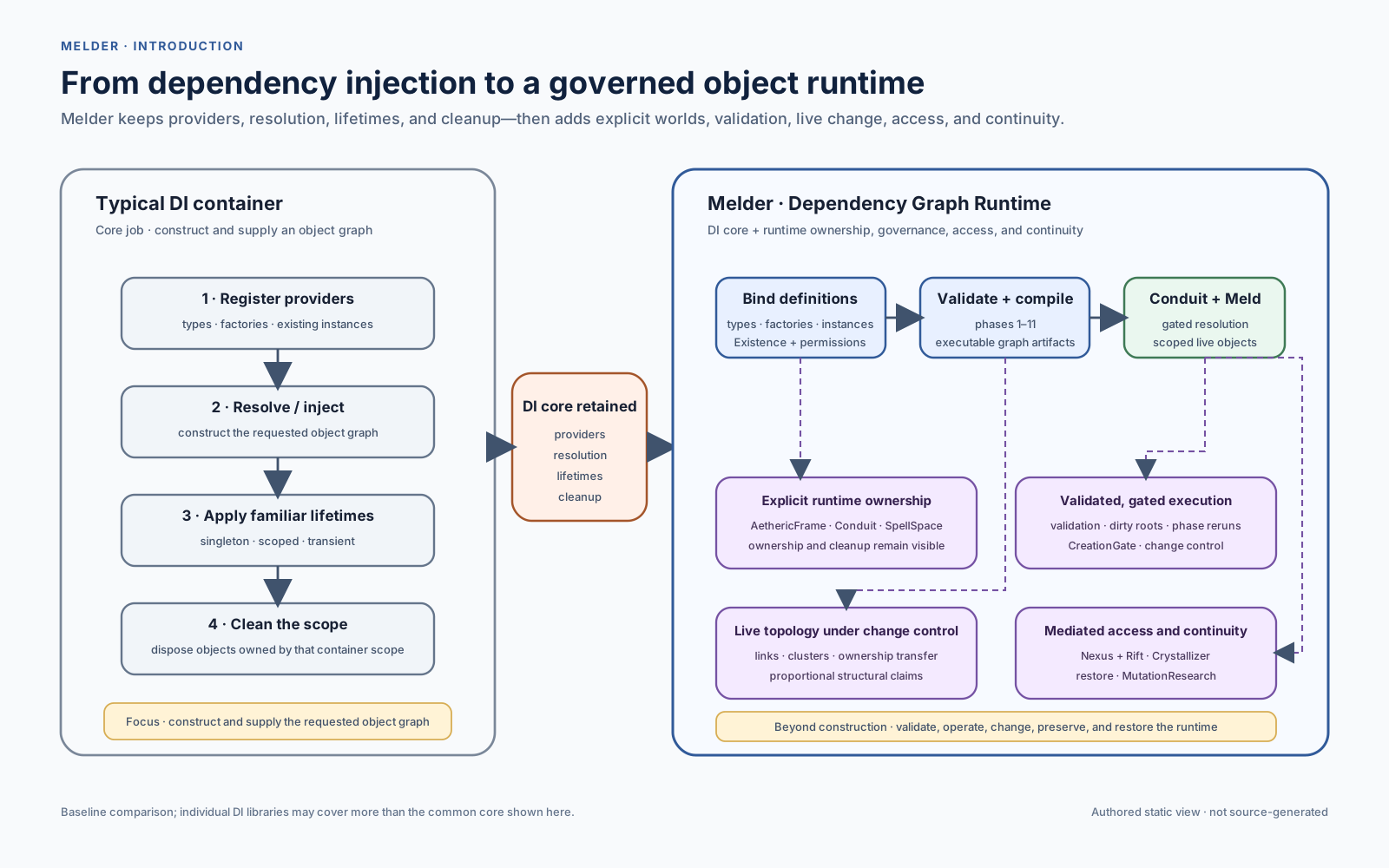
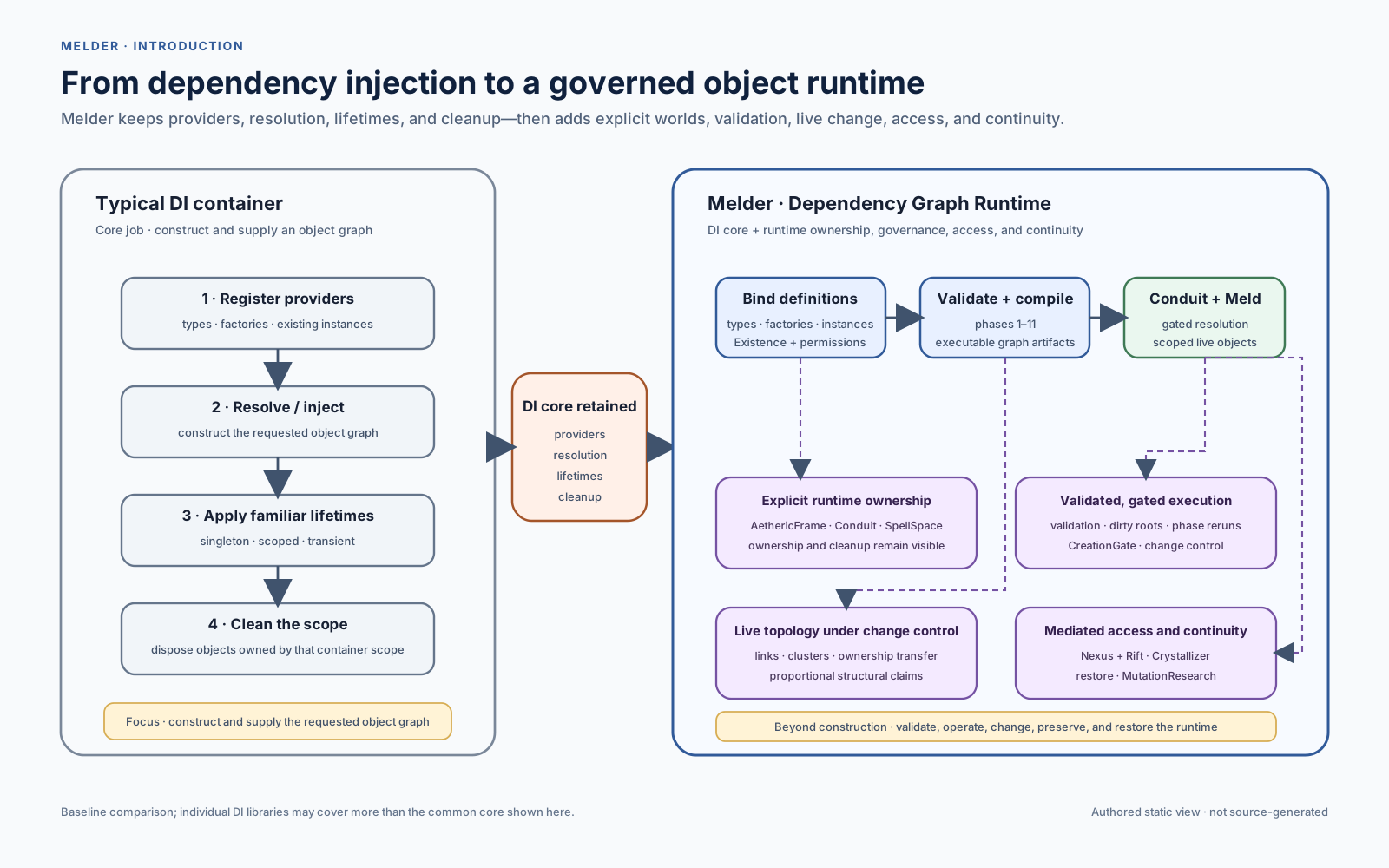
A typical DI container emphasizes a compact loop: register providers, resolve and inject an object graph, apply familiar lifetimes, then clean the owning scope. Exact features vary by library; that common baseline is the comparison point, not a universal limit on every DI implementation.
Melder keeps that baseline. Binding, resolution, lifetime selection, reuse, and cleanup remain central. It widens the unit of design from one constructed graph to a governed runtime world:
AethericFrames, Conduits, and SpellSpaces make runtime ownership boundaries explicit.
SpellCompiler and Frame DevOps validate, compile, gate, and lazily revalidate execution.
Dynamic worlds can link subsystems, form clusters, and transfer ownership through admitted structural transactions.
Nexus/Rift, Crystallizer, and MutationResearch add mediated operation, continuity, restore, and governed evolution above the DI core.
Open full-size SVG ·
Open the Mermaid companion ·
Read what Melder is
The Three-Level Descent
Level |
Question answered |
Primary picture |
Semantic companion |
|---|---|---|---|
C4 |
Where does Melder sit, and who interacts with it? |
||
C3 |
Which components own definition, execution, access, continuity, and change? |
||
C2 |
What happens inside one gated meld resolution? |
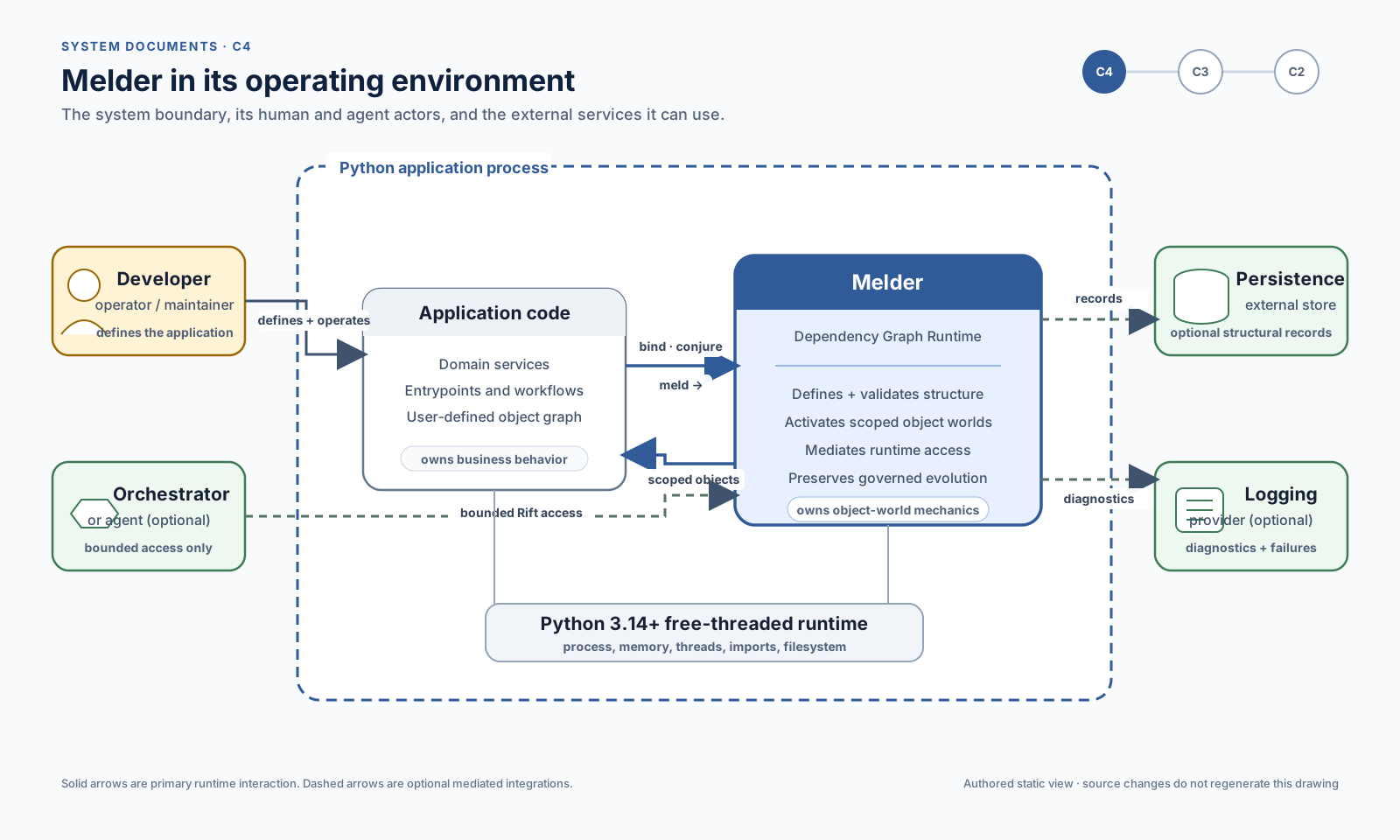
C4 — System Context
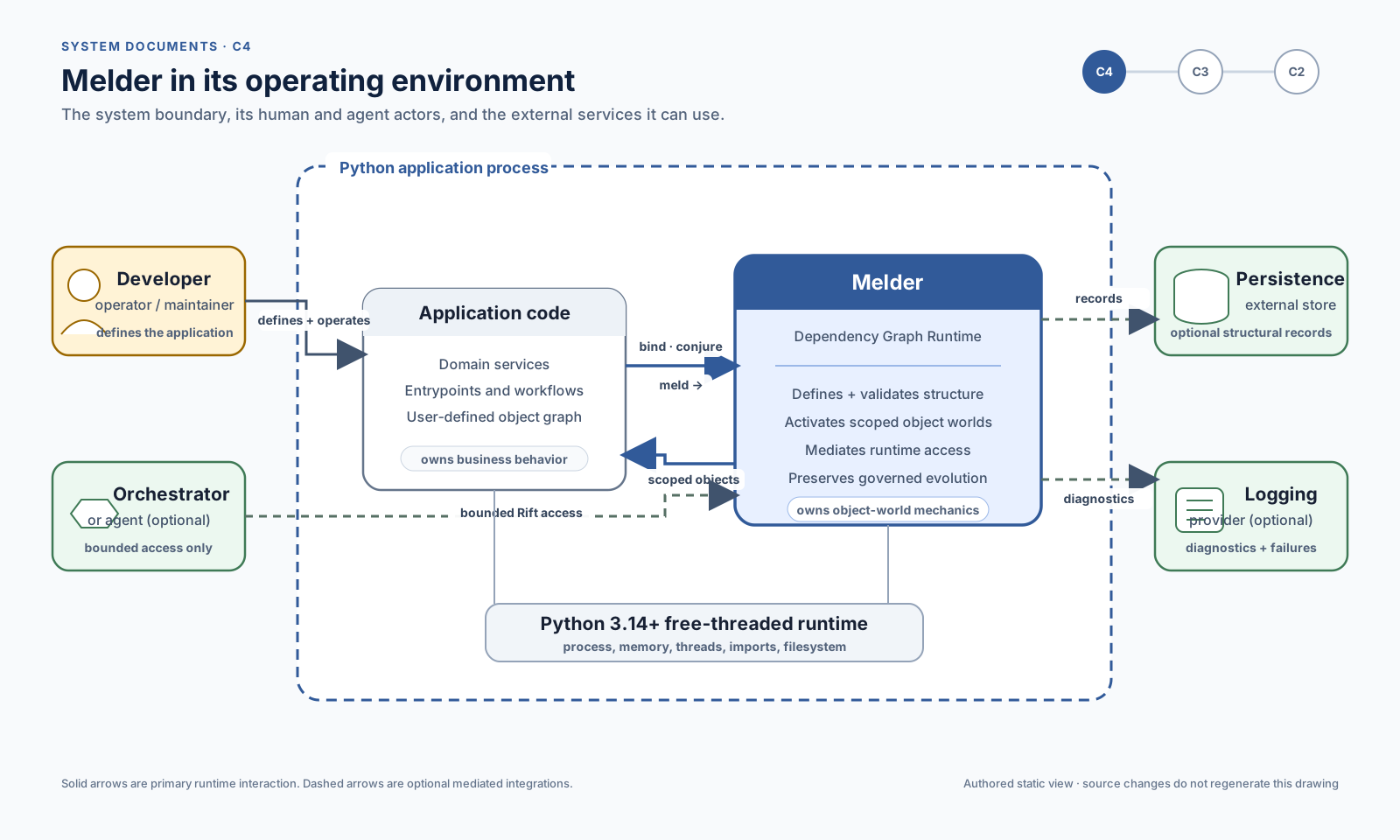
The C4 view establishes the boundary: application code and Melder share one Python process, while developers, optional agents, persistence, and logging interact across explicit edges.
Open full-size SVG ·
Open the Mermaid companion ·
Read the system-context prose
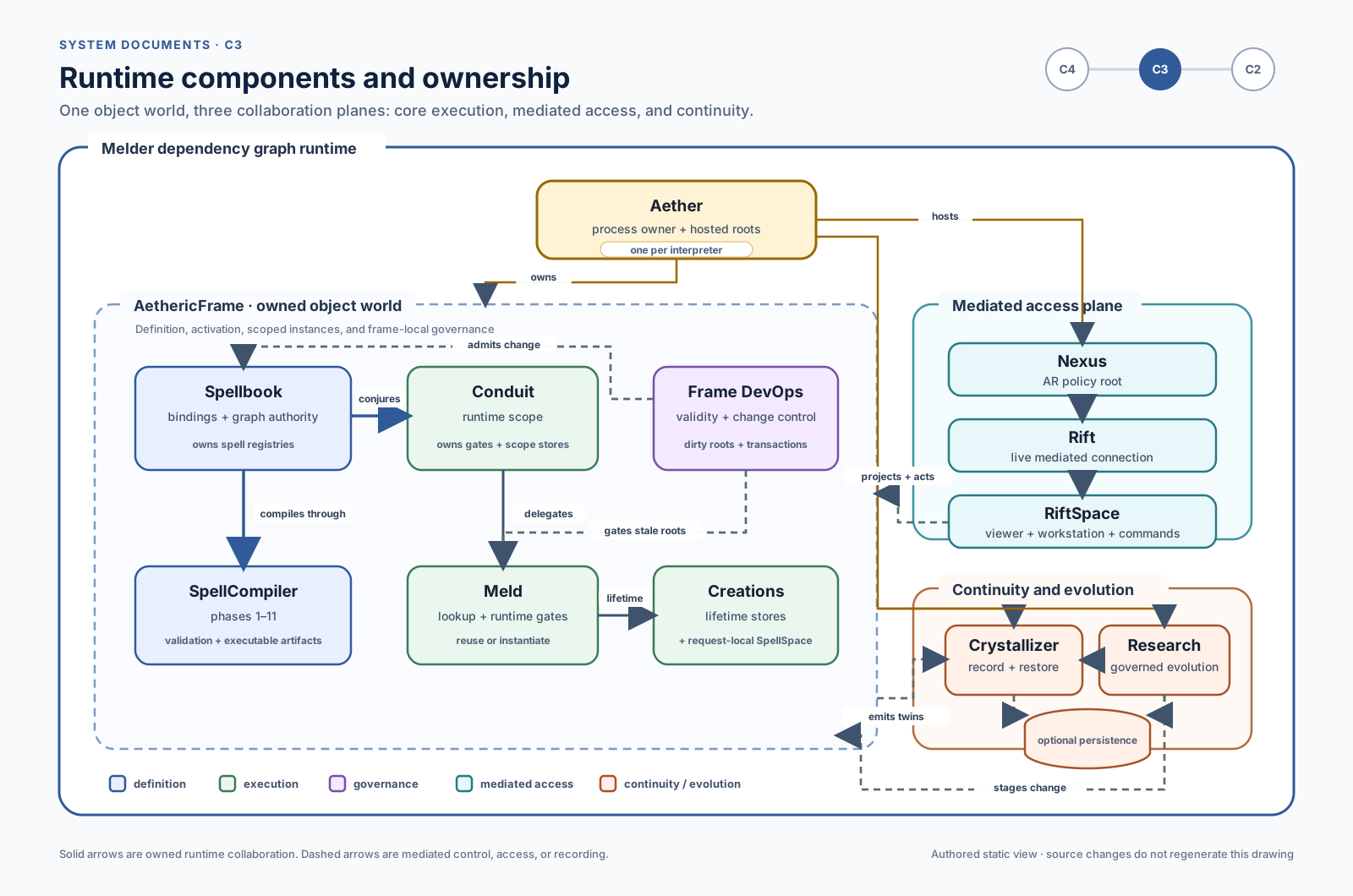
C3 — Runtime Components
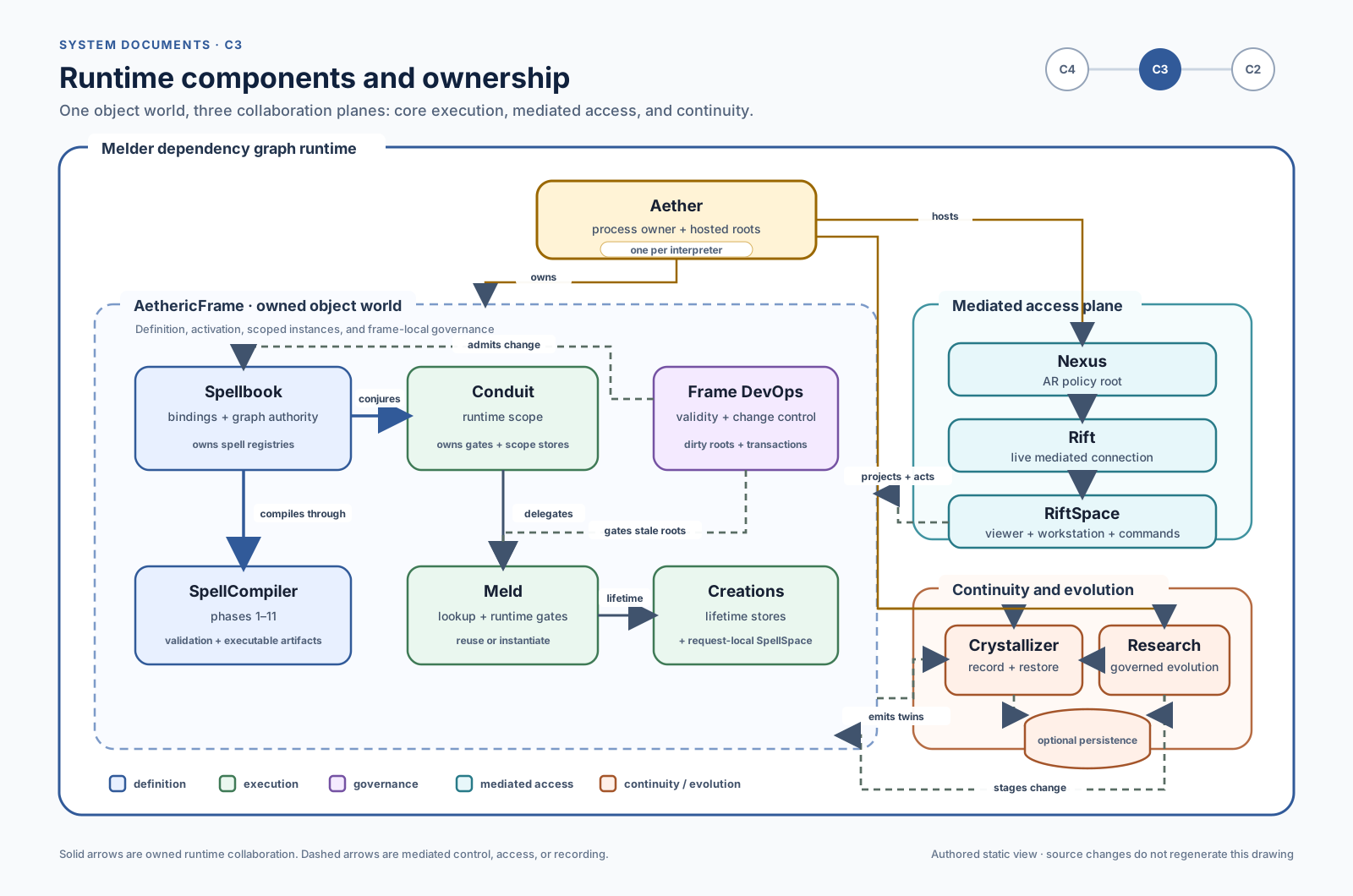
The C3 view opens Melder into three collaboration planes. The frame-owned core handles definition, activation, object lifetimes, and validity. Nexus/Rift mediates access. Crystallizer and MutationResearch handle continuity and governed evolution.
Open full-size SVG ·
Open the Mermaid companion ·
Read the runtime-model prose
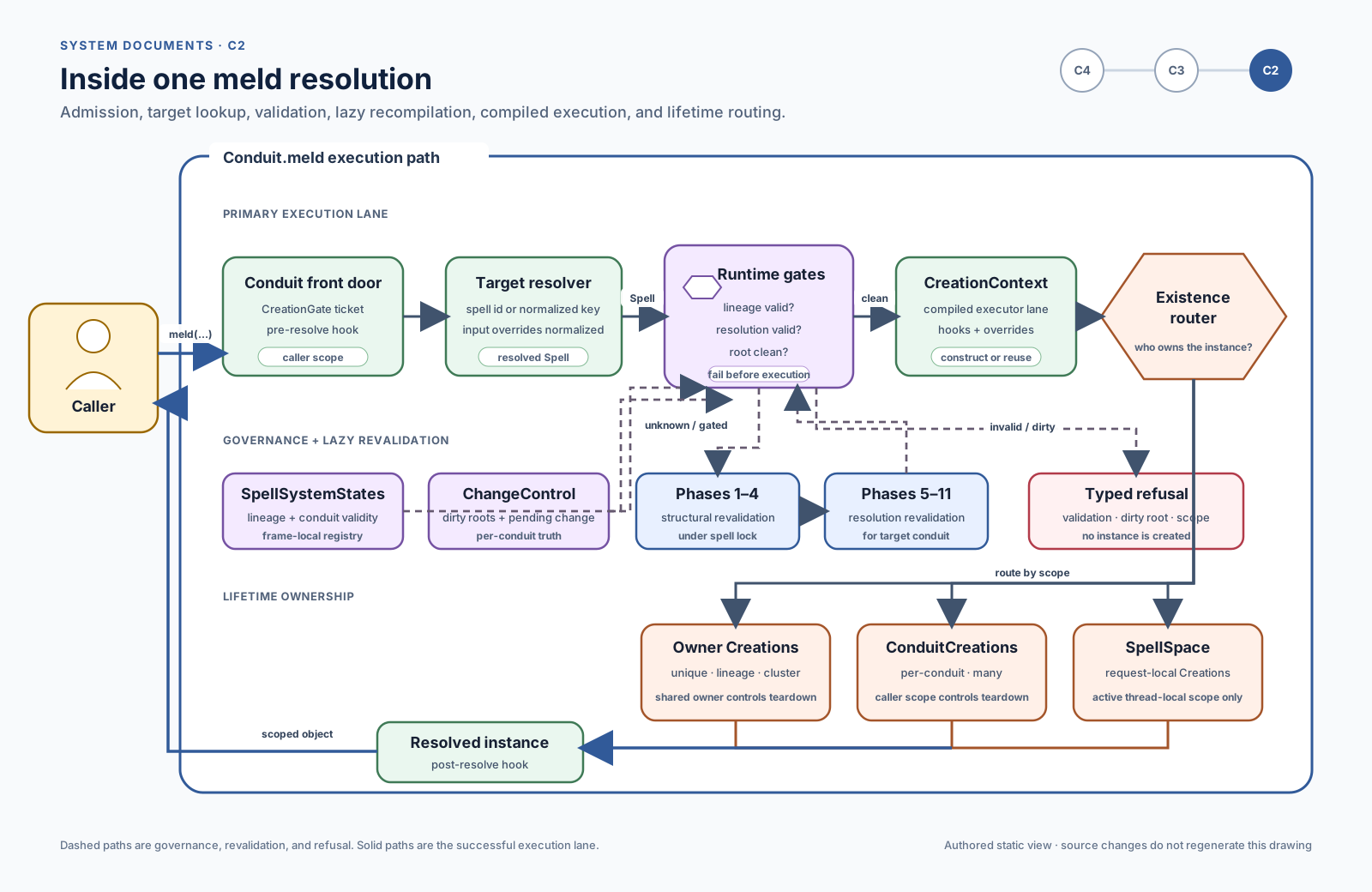
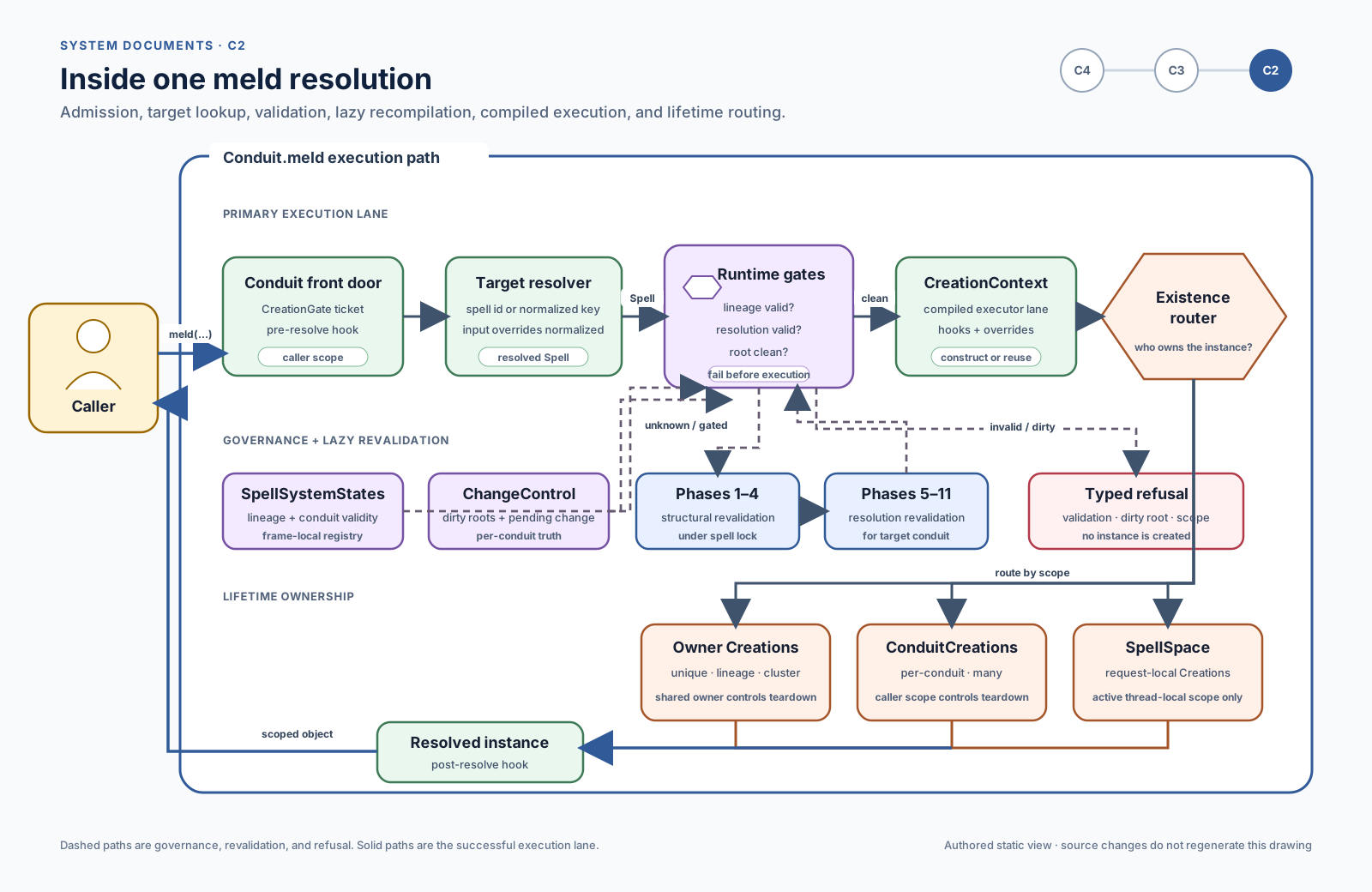
C2 — Meld Resolution
The C2 view follows Conduit.meld through its CreationGate, target lookup, lineage
and dirty-root checks, lazy revalidation, compiled CreationContext, and
Existence-directed lifetime stores.
Open full-size SVG ·
Open the Mermaid companion ·
Read ownership and lifetimes
Actor-Centered Use Cases
These views answer why a developer, application, operator, or agent enters the system. They complement the structural ladder rather than adding another architecture level.
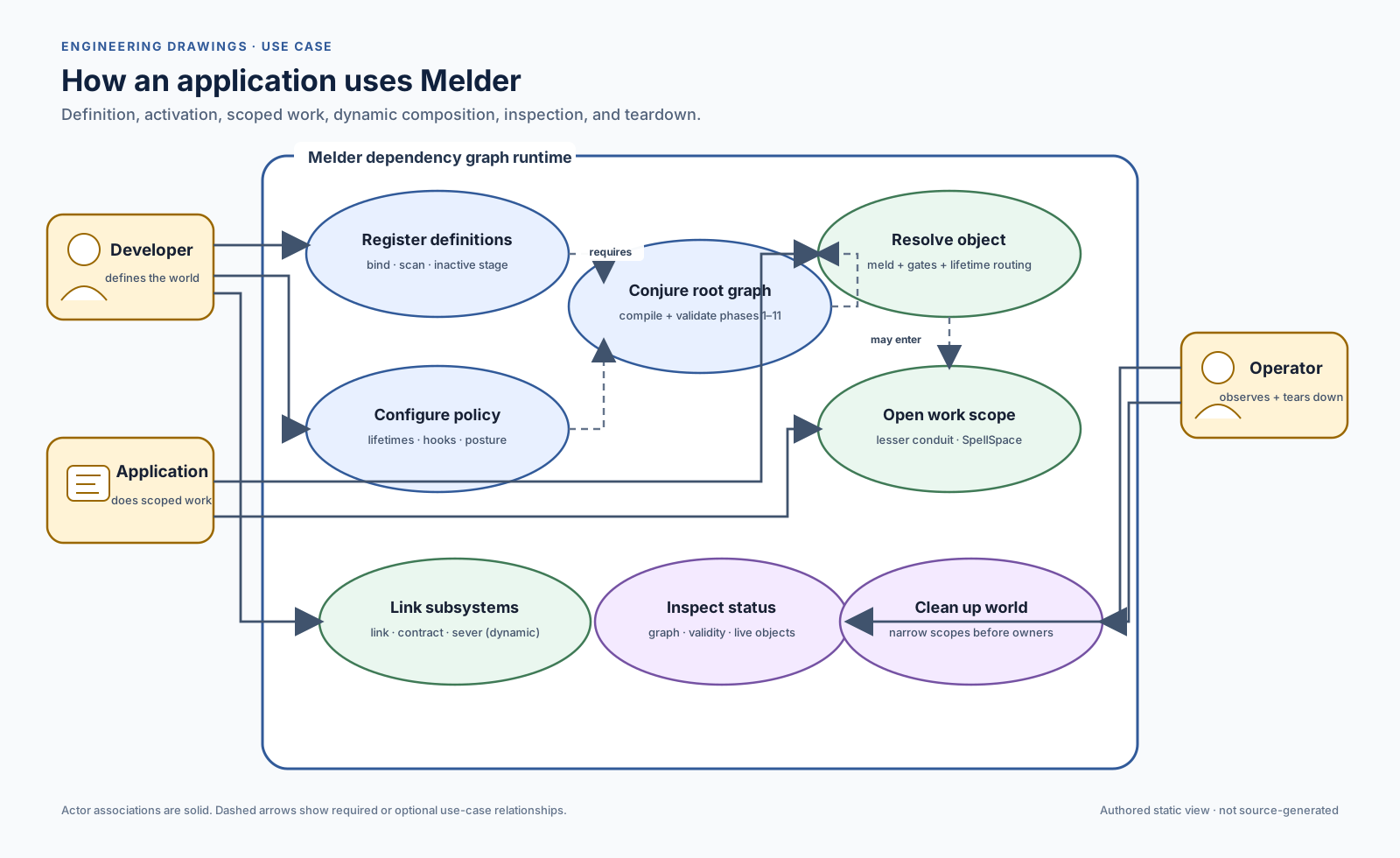
Application Runtime Use Cases
Developers define and activate the object world through registration, configuration, and conjure. Application code resolves objects and opens narrower work scopes. Operators inspect current truth and drive deterministic teardown. Dynamic applications can also link or sever independently owned conduit subgraphs without rebuilding the whole process.
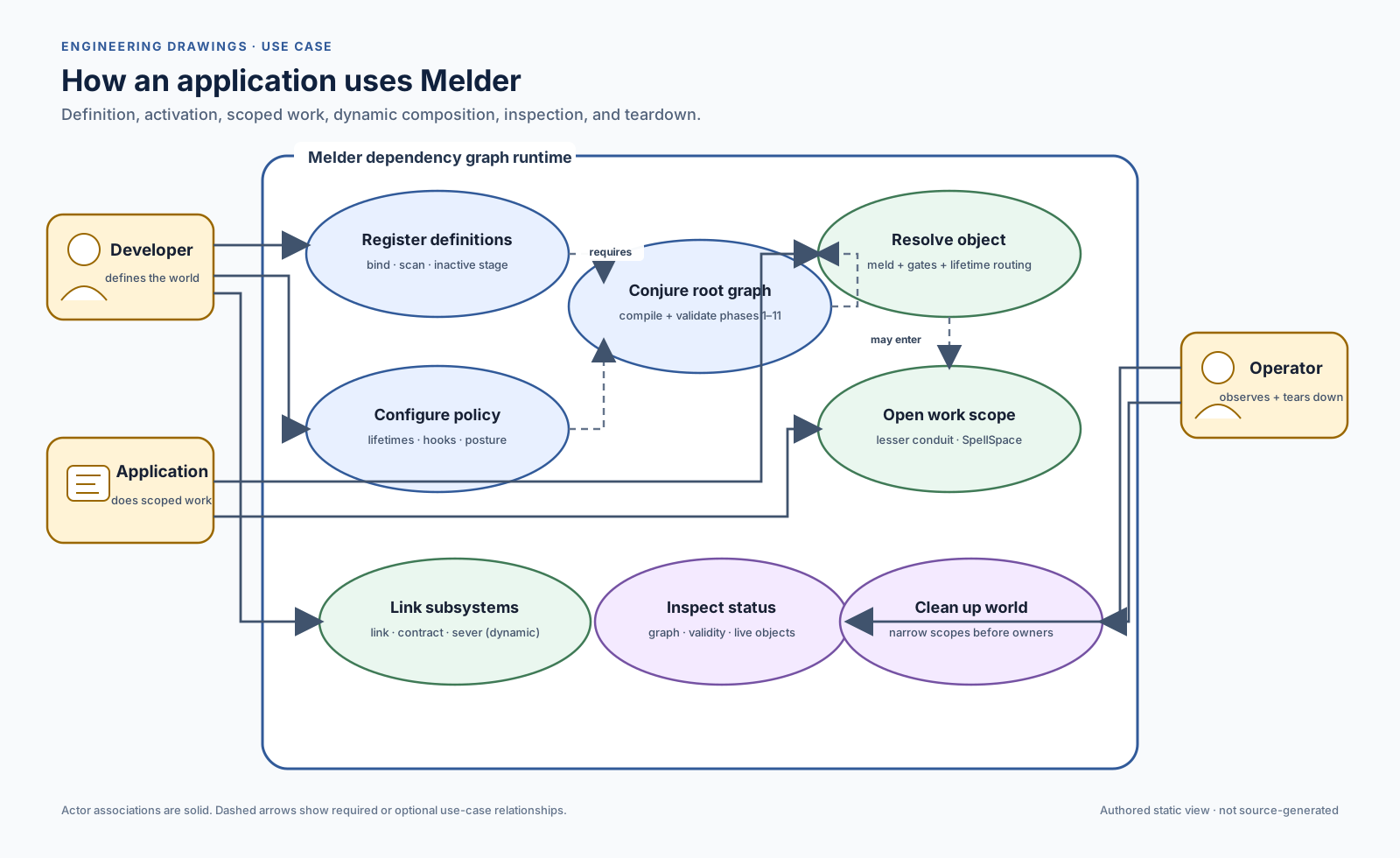
Open full-size SVG ·
Open the Mermaid companion ·
Read how to compose an application
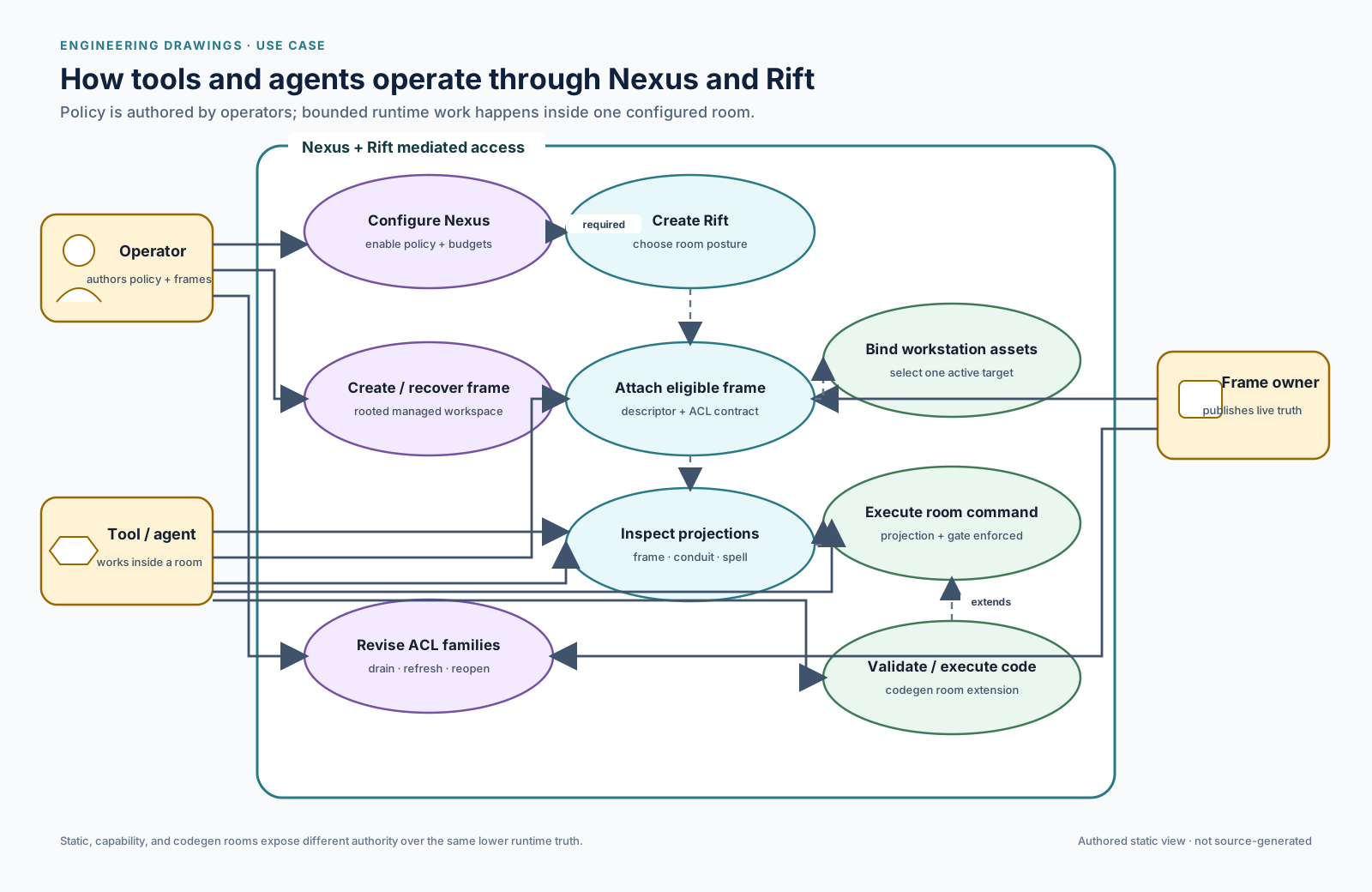
Nexus and Rift Use Cases
Nexus and Rift divide authority between two actors. An operator authors process policy, managed-frame topology, ACL families, and refresh behavior. A tool or agent enters a named Rift, links an eligible frame, inspects current projections, binds selected assets in the room workstation, and acts through the room command surface.
Room posture is part of the contract:
static rooms expose live, reuse-oriented inspection;
capability rooms expose broader manual runtime operations;
codegen rooms add validated namespace construction and execution.
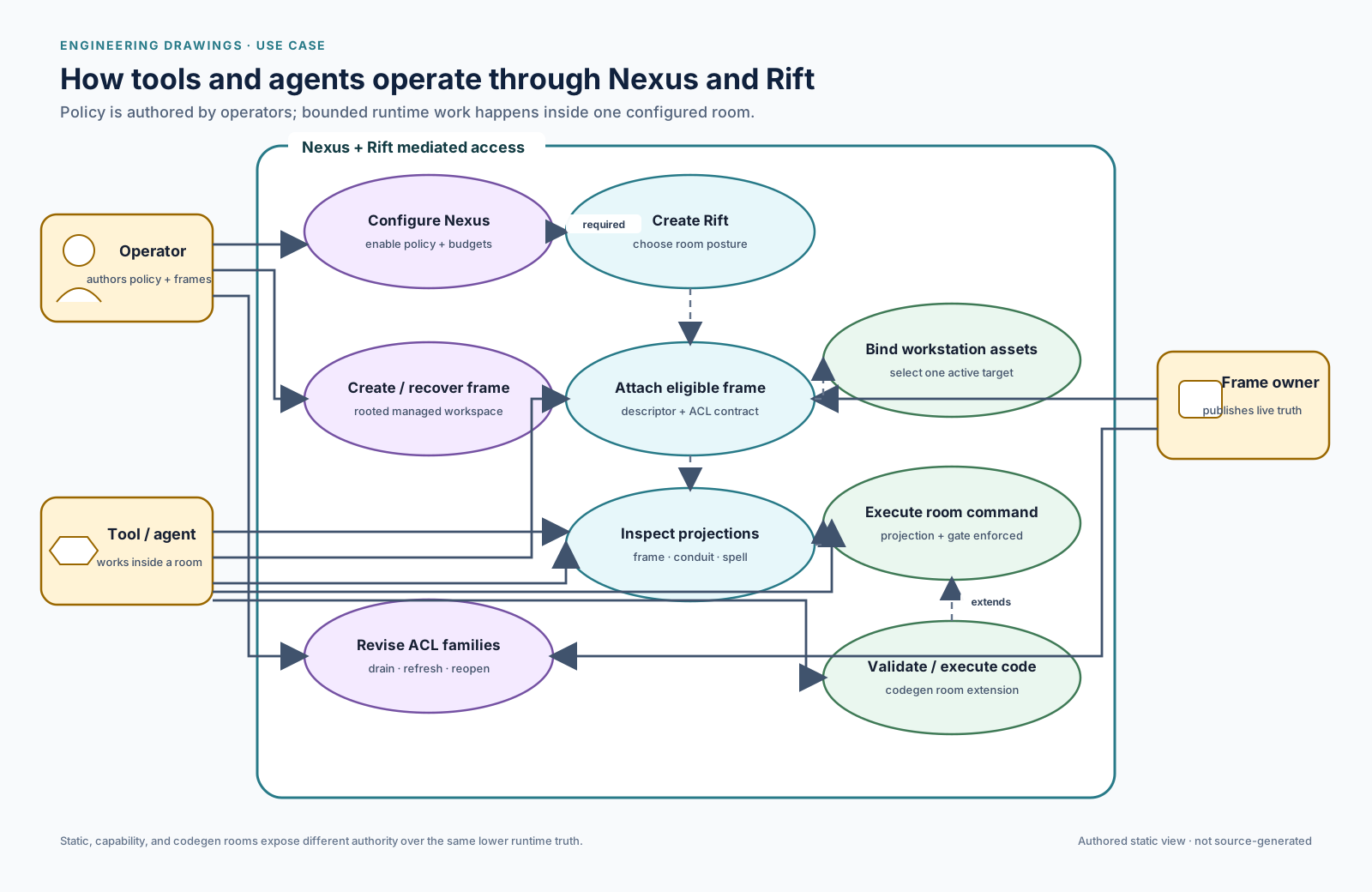
Open full-size SVG ·
Open the Mermaid companion ·
Read mediated runtime access
Continuity and Research Use Cases
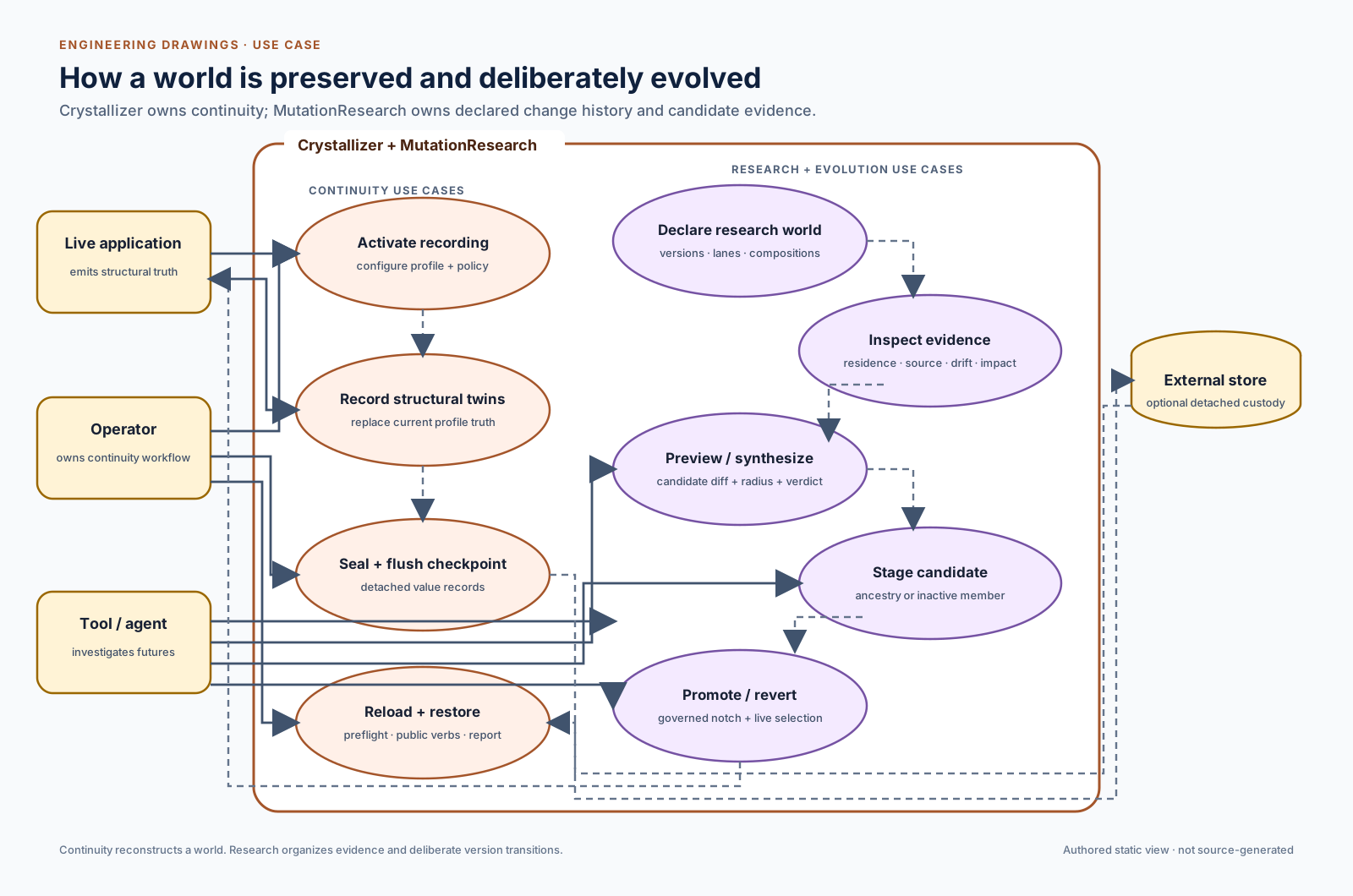
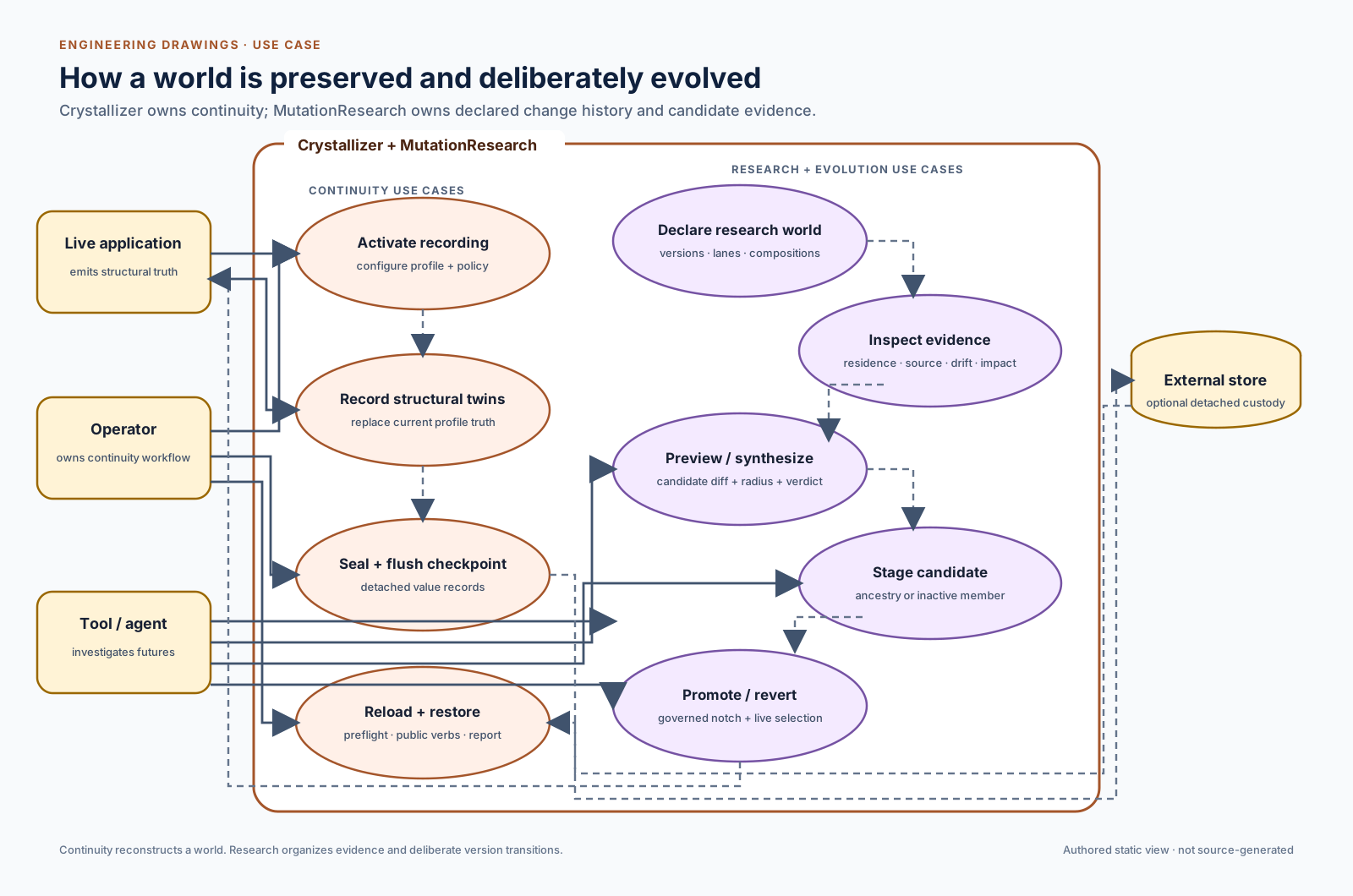
Crystallizer and MutationResearch solve different problems. Crystallizer records structural twins, seals checkpoints, and reconstructs a fresh world. MutationResearch declares version and composition history, joins runtime residence with recorded custody, exposes source/drift/diff/impact evidence, rehearses candidates, and records deliberate promotion.
The separation matters: a restored world is not the same event as a promoted version, and a preview is not a mutation.
Open full-size SVG ·
Open the Mermaid companion ·
Read continuity and evolution
Scoped Lifetime Use Cases
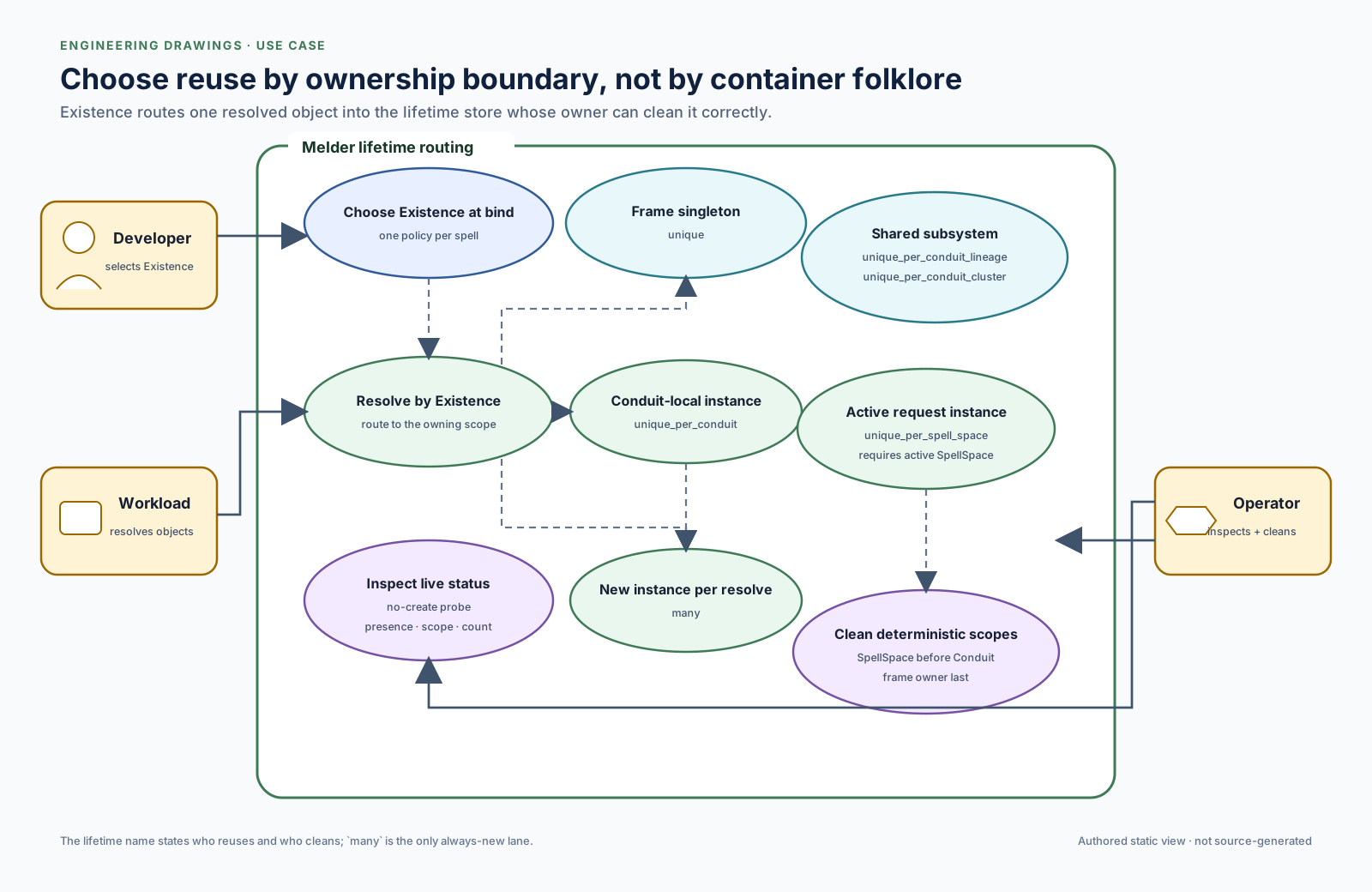
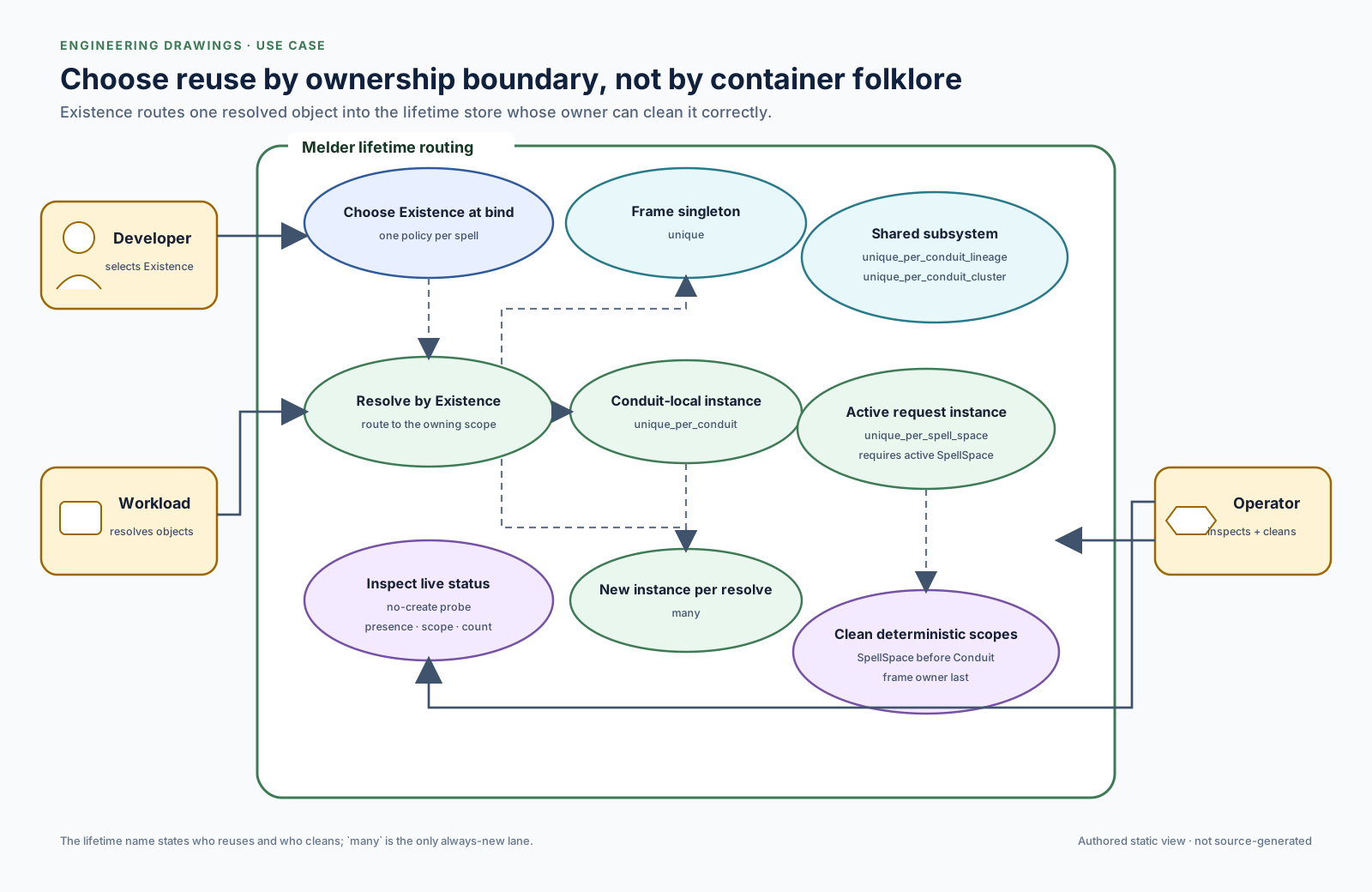
Existence is the ownership and reuse contract for a resolved object. It is selected when a spell is bound, then Meld routes the resulting instance into the matching owner's store:
uniquebelongs to one AethericFrame;unique_per_conduit_lineageandunique_per_conduit_clustershare within an explicitly related subsystem boundary;unique_per_conduitbelongs to one Conduit;unique_per_spell_spacerequires an active request-local SpellSpace;manycreates a new instance for each resolution.
The no-create probe answers whether a matching live object already exists without changing runtime state. Cleanup then composes two orderings: narrow scopes before broad owners, and newest-created objects before their dependencies.
Open full-size SVG ·
Open the Mermaid companion ·
Scope application work
Linked Subsystem Use Cases
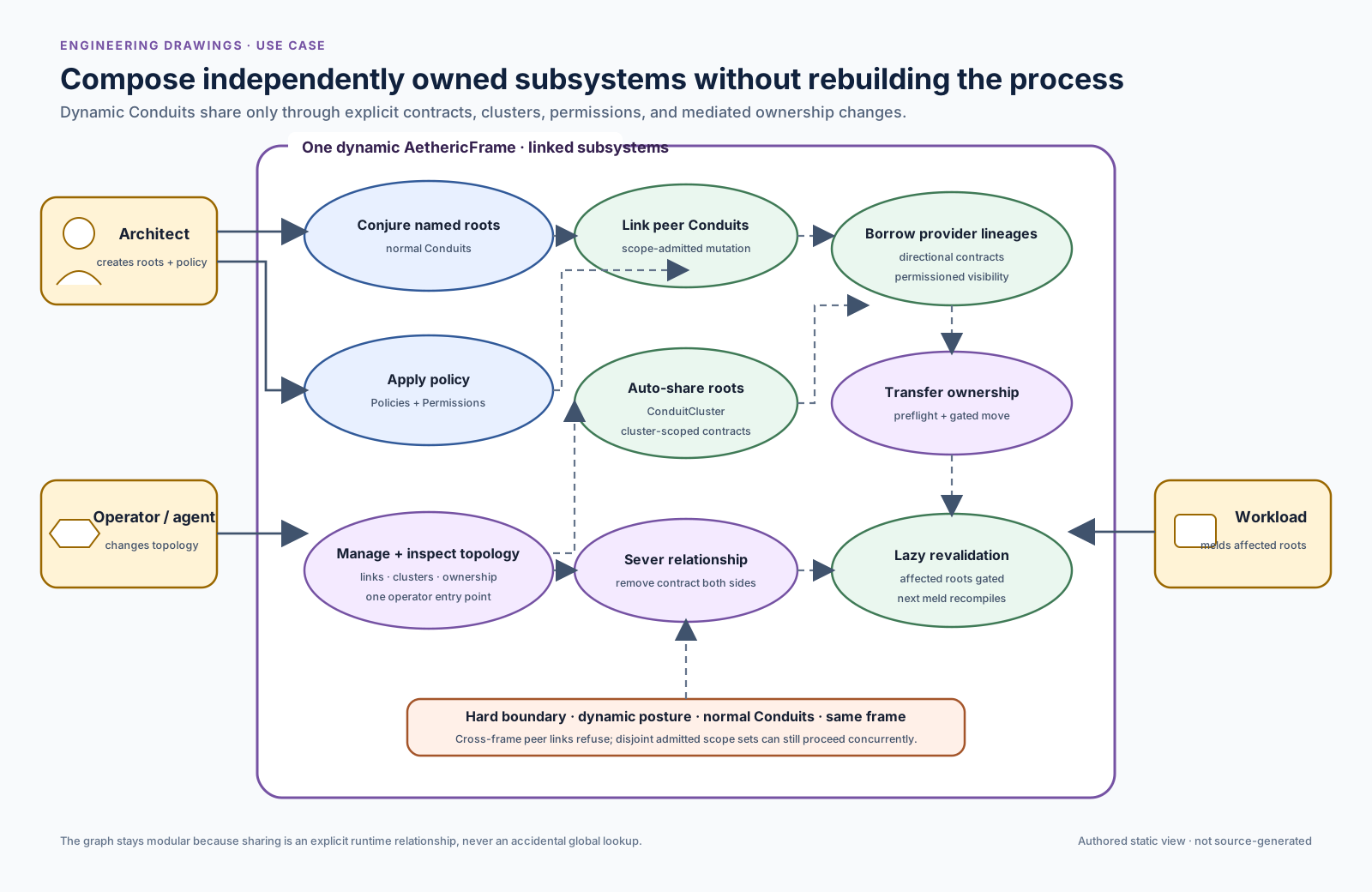
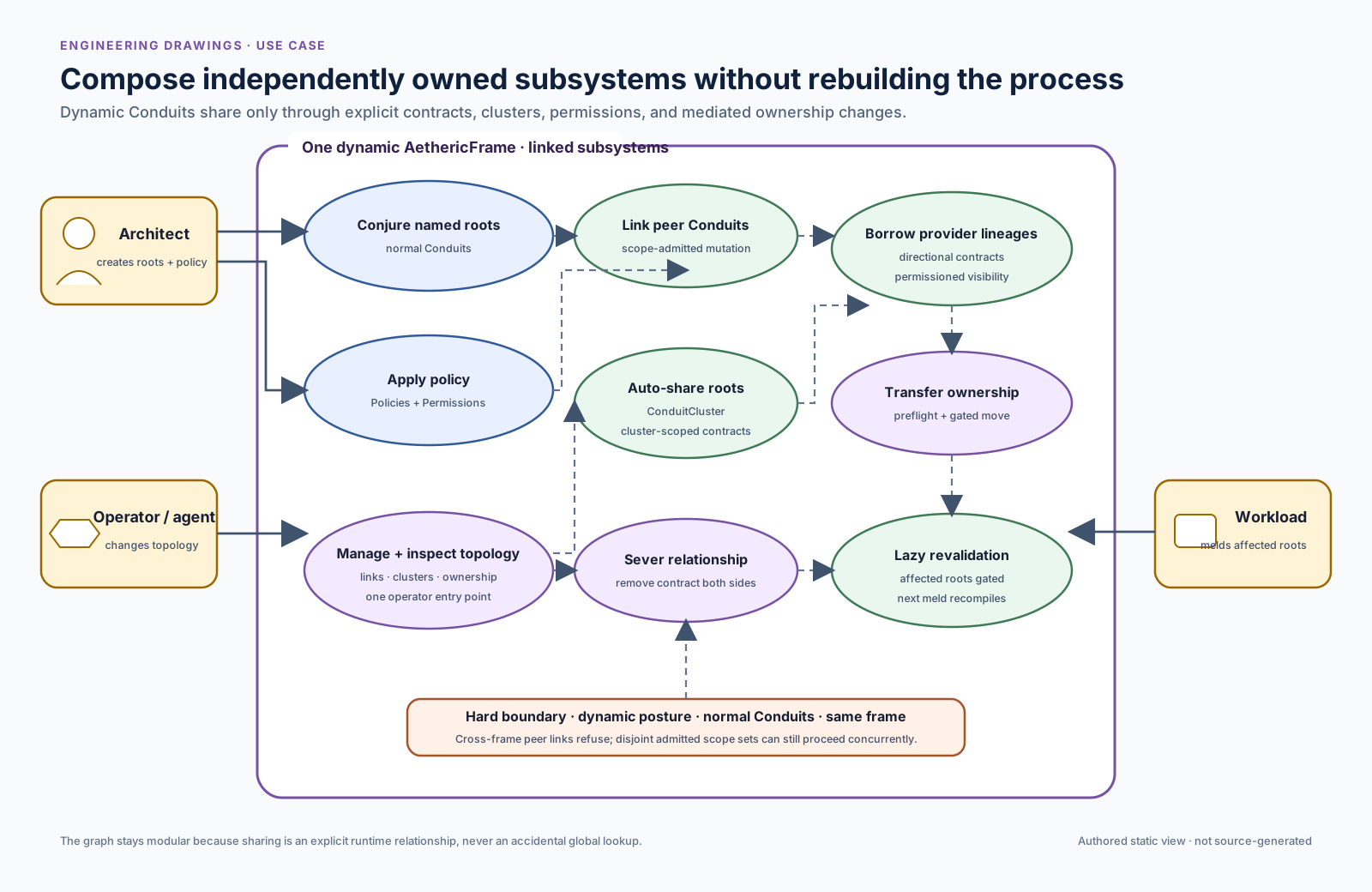
Dynamic Conduits can remain separately owned while sharing selected graph surfaces.
Peer links create directional contracts governed by Policies and per-spell
Permissions; ConduitCluster provides automatic root-lineage sharing; ownership
transfer and severing remain explicit structural mutations.
Three boundaries keep this composition honest:
peers are normal Conduits in the same AethericFrame;
the frame posture is dynamic;
structural mutations acquire proportional scope claims, so disjoint changes can proceed while true overlap waits.
Affected roots are gated and lazily revalidated on the next meld rather than rebuilt eagerly as a side effect of every topology change.
Open full-size SVG ·
Open the Mermaid companion ·
Connect independently owned subsystems
Isolated Runtime World Use Cases
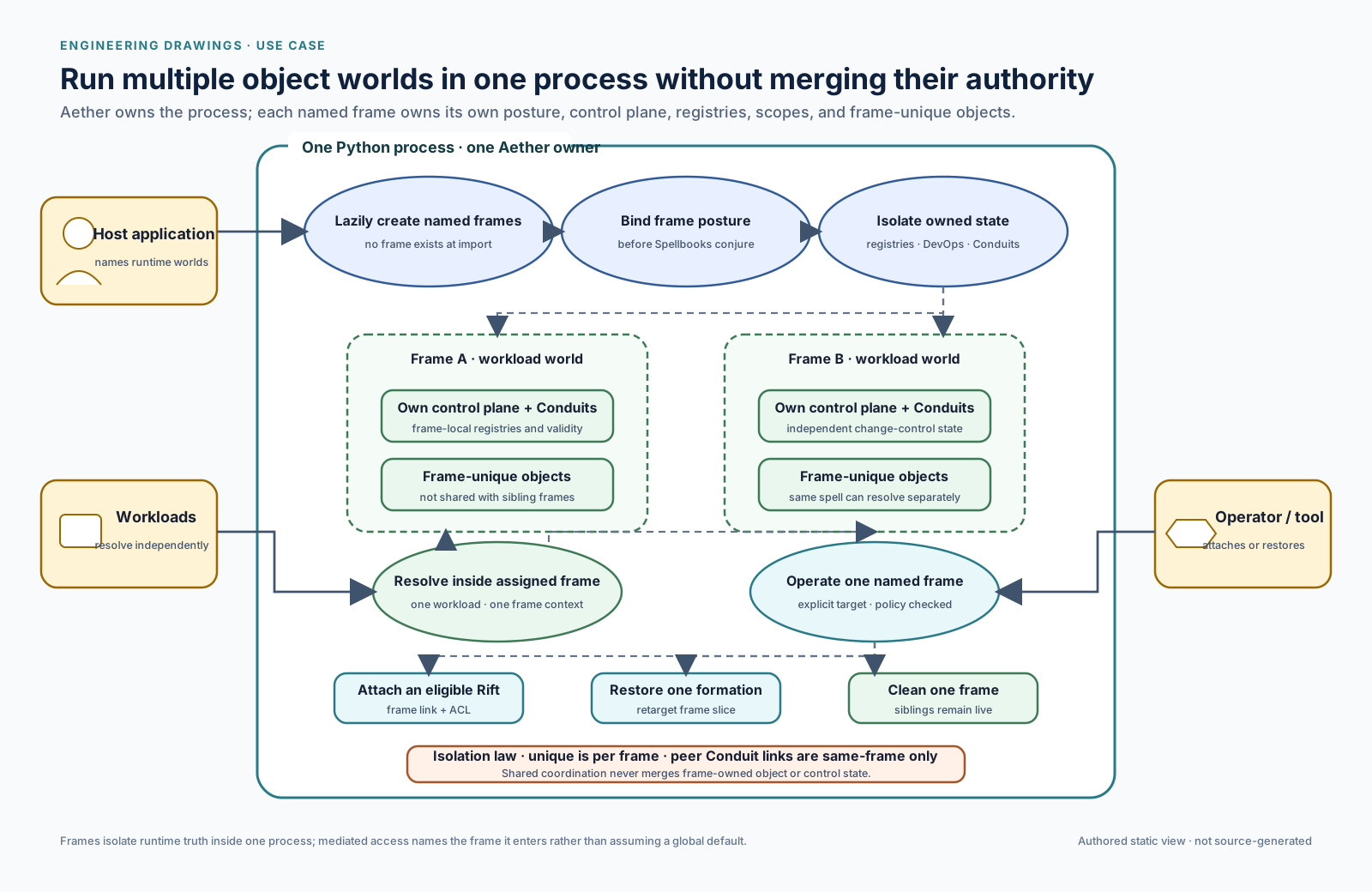
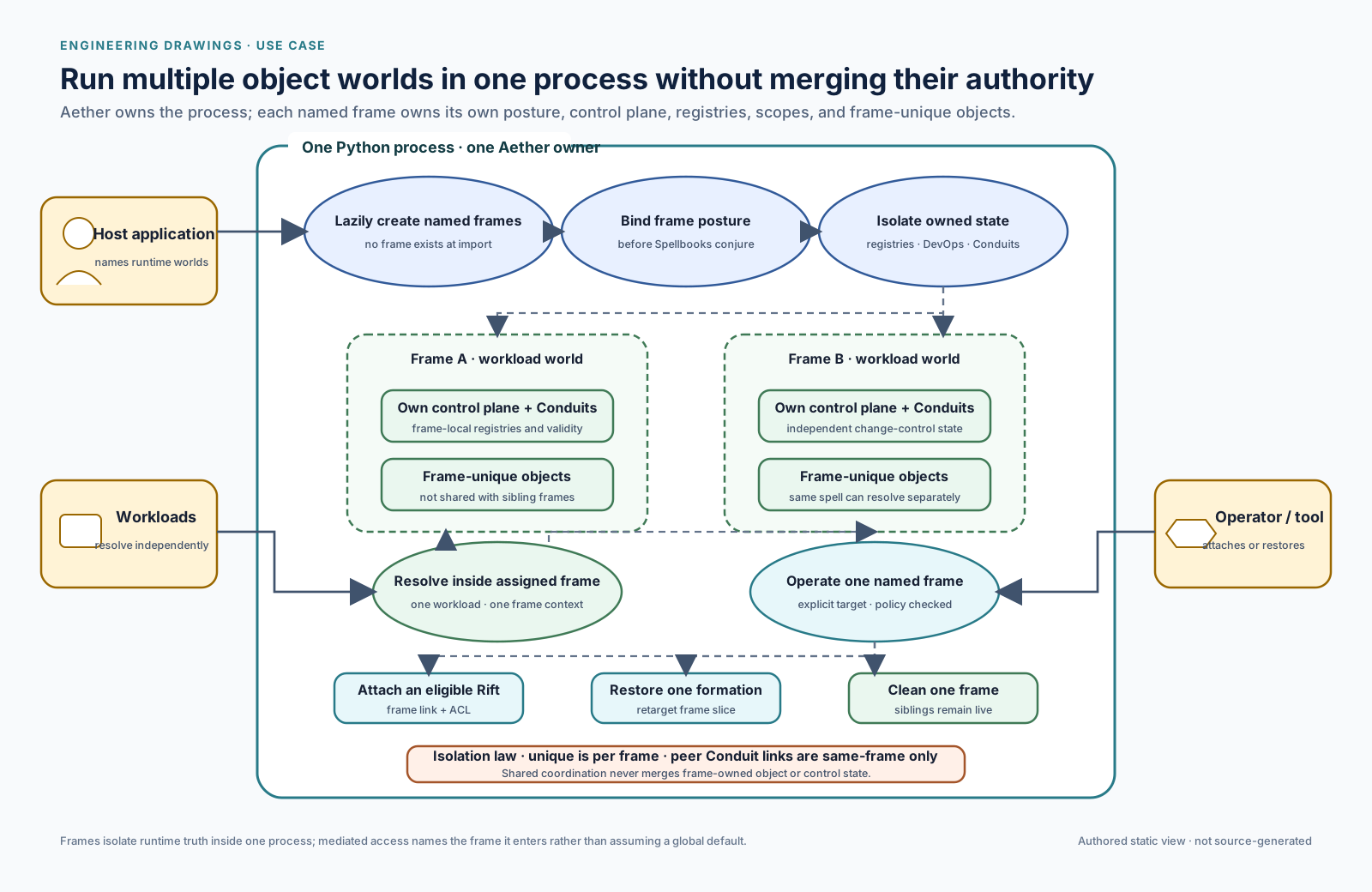
One Aether process owner can host multiple named AethericFrames. Frames are created lazily, receive their posture before Spellbooks conjure into them, and keep their own registries, DevOps control plane, Conduits, and frame-unique objects.
This supports independent application worlds inside one process without turning them into a single global container. A workload resolves inside its assigned frame. An operator can attach a Rift to one explicitly eligible frame, restore a formation into one target frame, or clean one frame without collapsing its siblings. Peer Conduit links remain same-frame only.
Open full-size SVG ·
Open the Mermaid companion ·
Isolate object worlds
Cross-Cutting Engineering Flows
Boot and Ownership Lifecycle
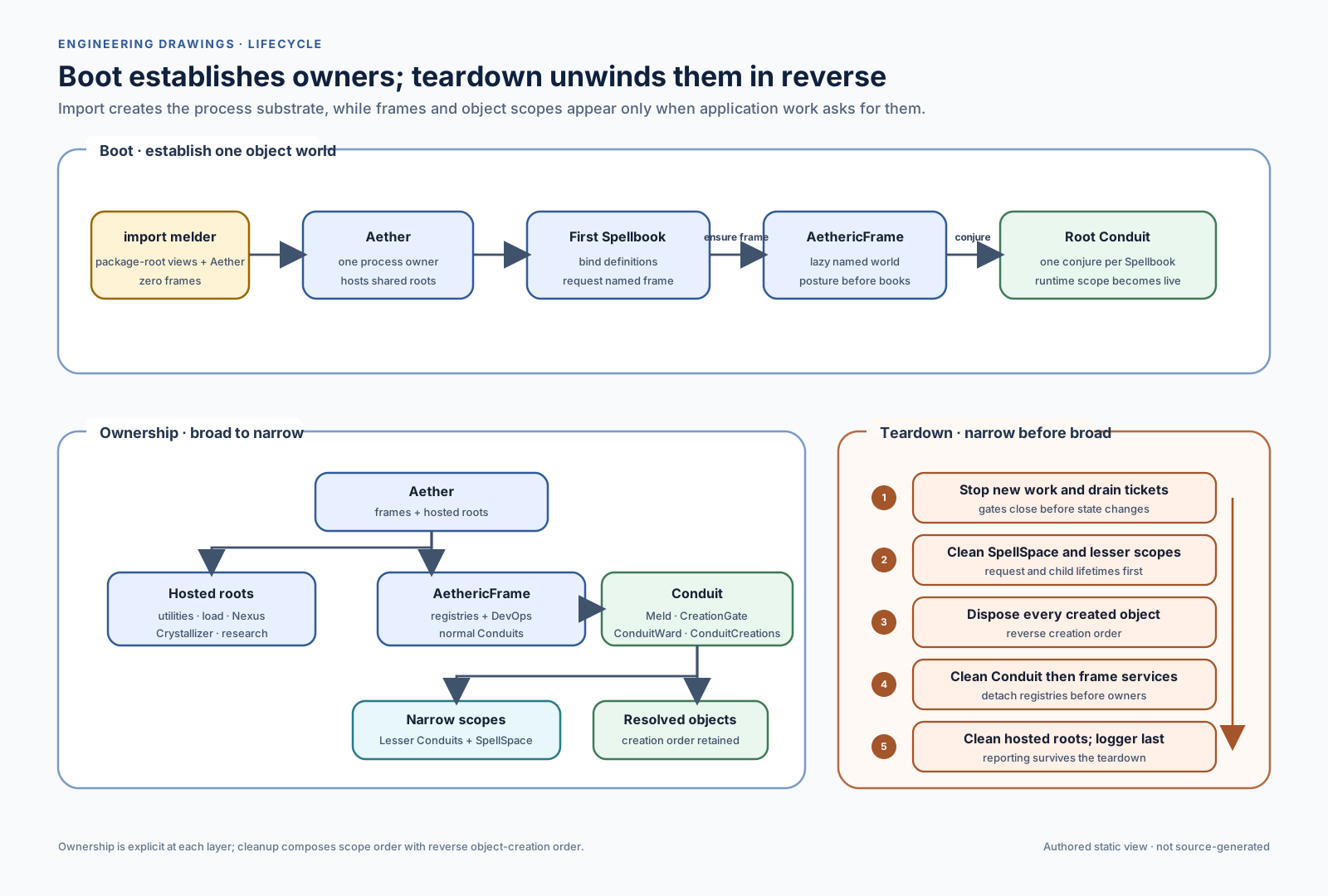
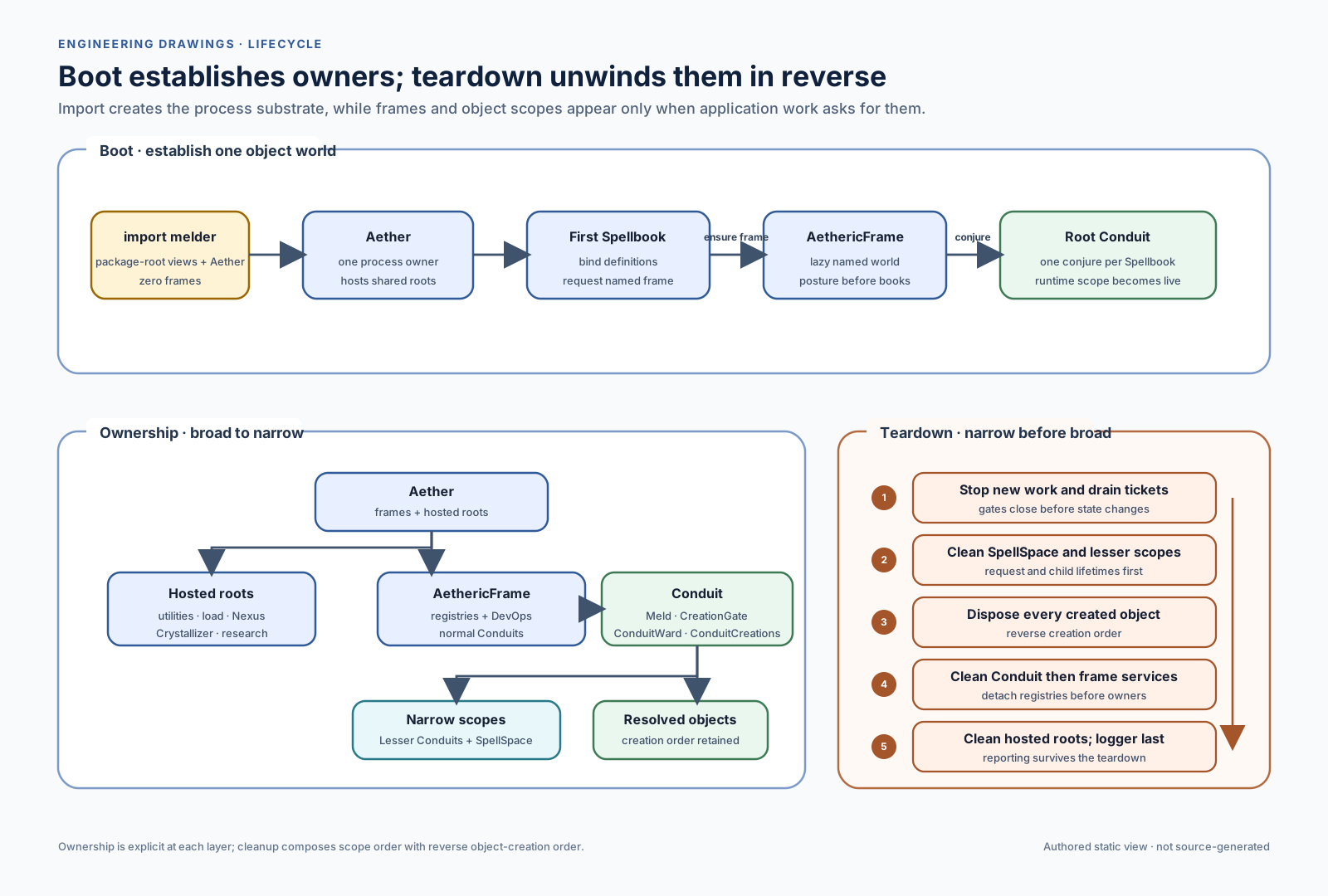
import melder creates the package-root document views and the Aether singleton, but
it creates no frame. Aether hosts the shared utility, load, continuity, and access
roots. The first Spellbook lazily establishes its named frame, binds definitions, and
conjures one root Conduit.
Ownership then narrows. The frame owns its registries and control plane. A Conduit owns Meld, CreationGate, ConduitWard, ConduitCreations, and its narrower scope pools. The resolved objects retain creation order so teardown can proceed safely in reverse.
Shutdown closes admission before changing state, drains active tickets, cleans SpellSpace and lesser scopes, disposes created objects newest-first, detaches Conduit and frame services, then cleans hosted roots. Logger teardown stays last so failures remain reportable during the cascade.
Open full-size SVG ·
Open the Mermaid companion ·
Read the runtime model
Free-Threaded Coordination
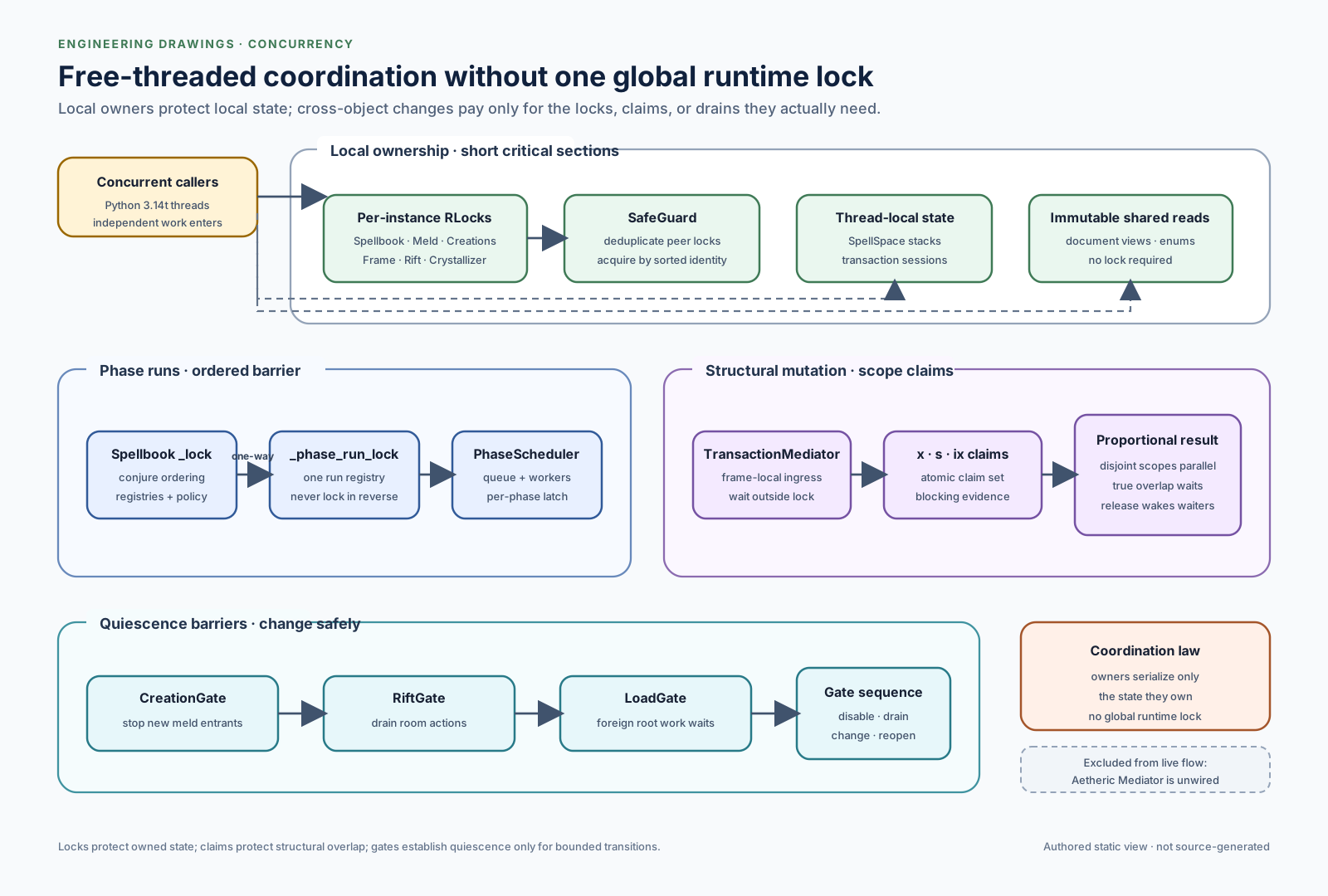
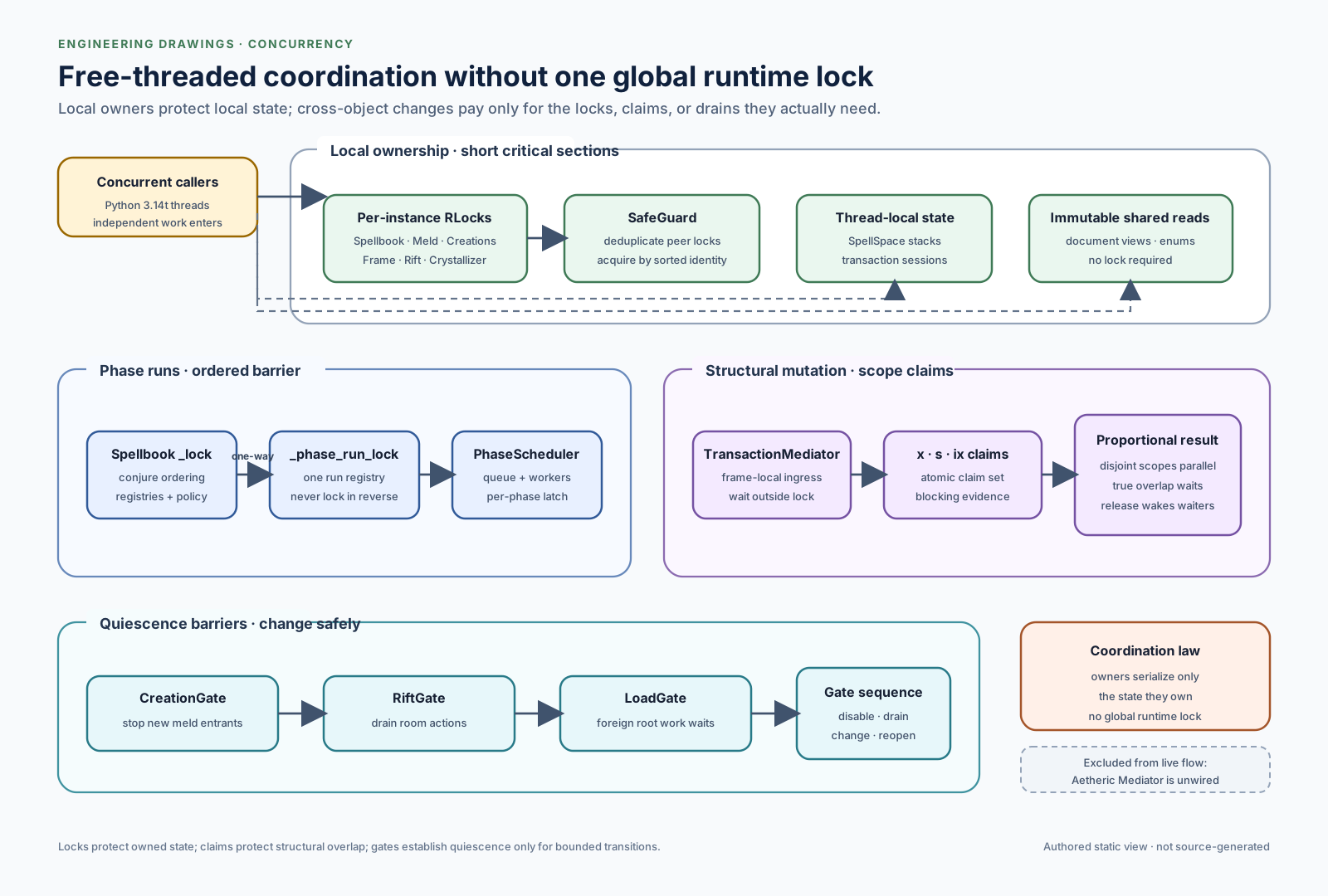
Melder does not coordinate the whole runtime through one global lock. Its mechanisms match the ownership or transition being protected:
per-instance
RLockobjects protect local mutable state;SafeGuard imposes deterministic identity ordering when one operation needs peer locks;
thread-local stacks isolate SpellSpace and transaction-session state;
Spellbook's
_phase_run_lockprotects the per-run phase registry, while PhaseScheduler executes units behind a per-phase barrier;frame TransactionMediator admits proportional
x,s, andixscope claims and waits outside its own lock;CreationGate, RiftGate, and LoadGate stop new entrants and drain bounded work before a structural change, projection refresh, or restore.
The standalone Aetheric Mediator package is deliberately excluded from the live path: it exists and is tested, but nothing constructs or submits runtime work through it.
Open full-size SVG ·
Open the Mermaid companion ·
Read the design tradeoffs
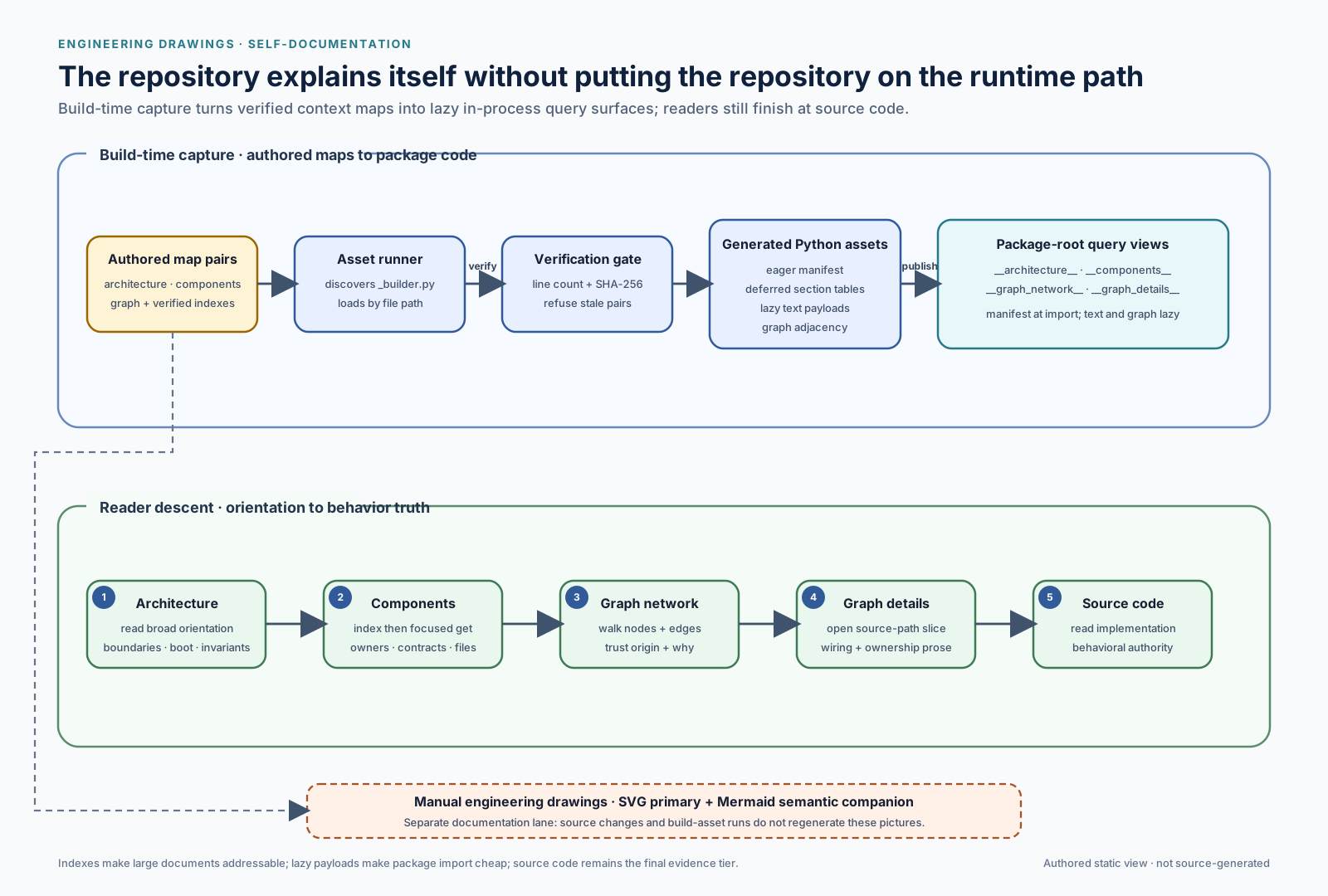
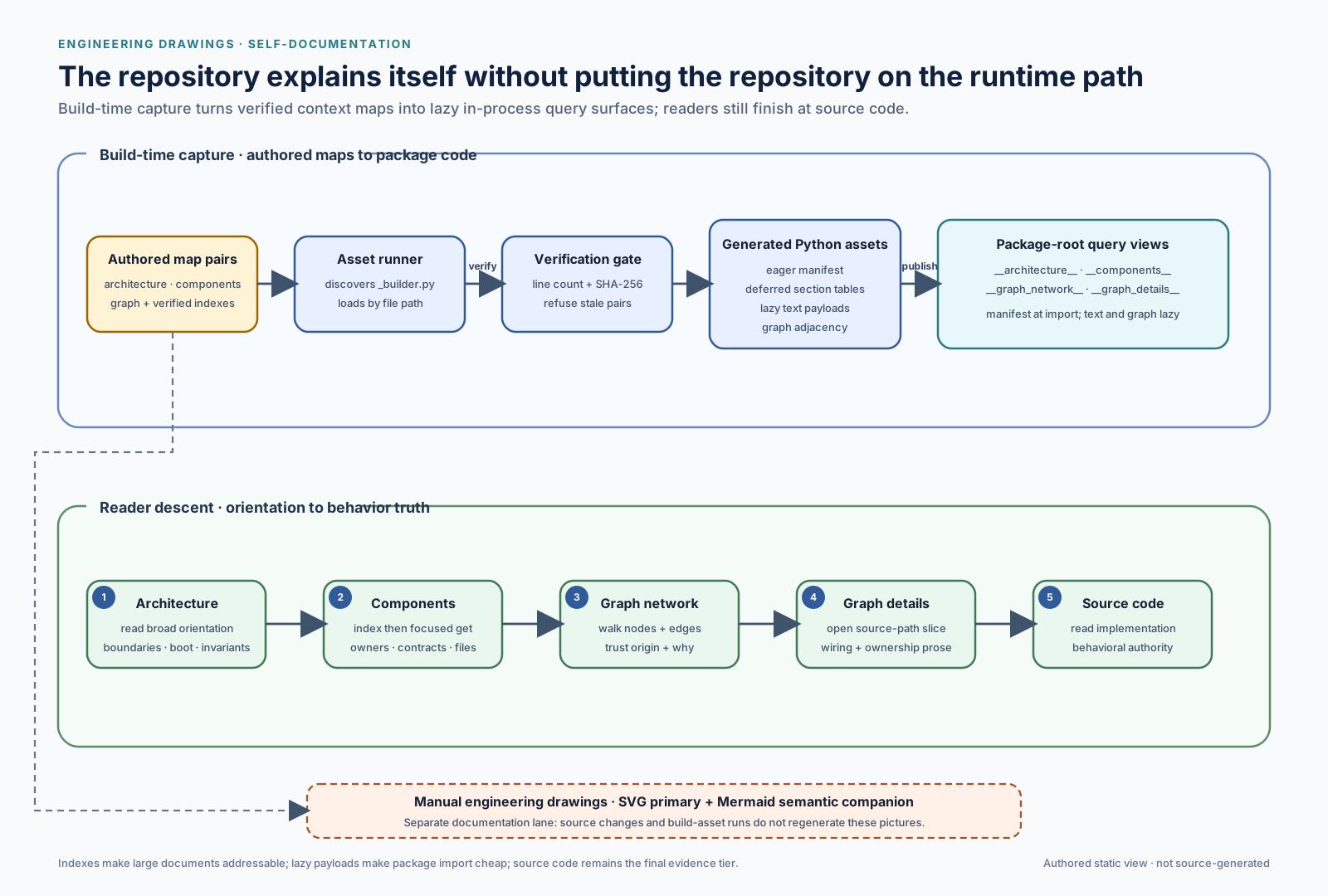
Self-Documentation Descent
The source maps remain authored documents. At build time, the discovery runner finds
the system-document builder, which verifies each document/index pair before emitting
an eager manifest, deferred section tables, lazy Python text payloads, and graph
adjacency. Runtime then publishes four package-root query views:
__architecture__, __components__, __graph_network__, and __graph_details__.
The reading path mirrors the information hierarchy:
read architecture broadly for boundaries, boot order, invariants, and vocabulary;
use the component index and open only the component branch in scope;
walk the graph network for nodes, edges, trust origin, and impact;
open the source-path graph detail that names the implementation files;
read source code, which remains the authority for current behavior.
The engineering drawings do not enter this generator. They remain manually composed SVGs with Mermaid semantic companions, so build-asset runs never overwrite deliberate layout or architectural judgment.
Open full-size SVG ·
Open the Mermaid companion ·
Return to the reader journey
Failure, Rollback, and Recovery
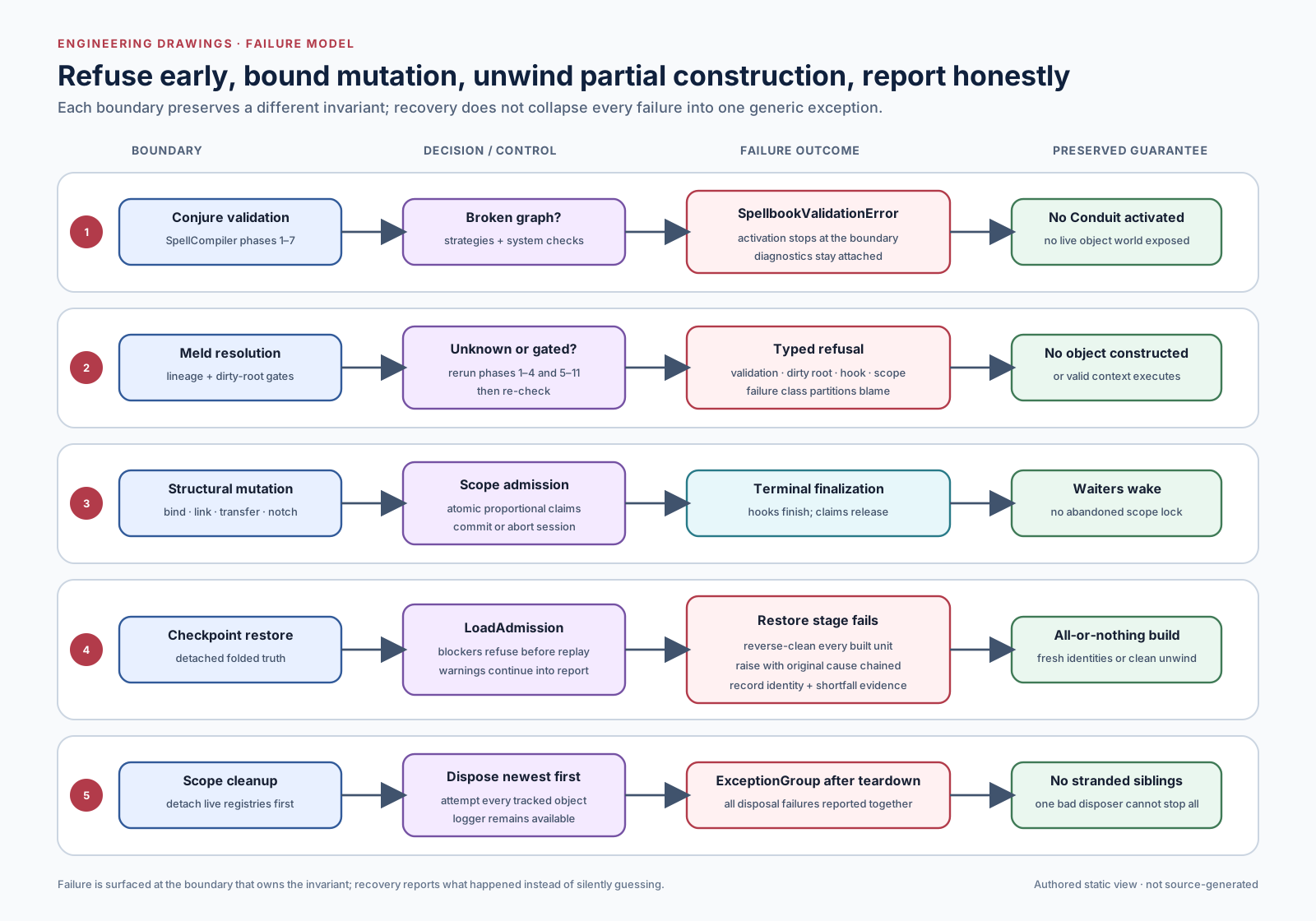
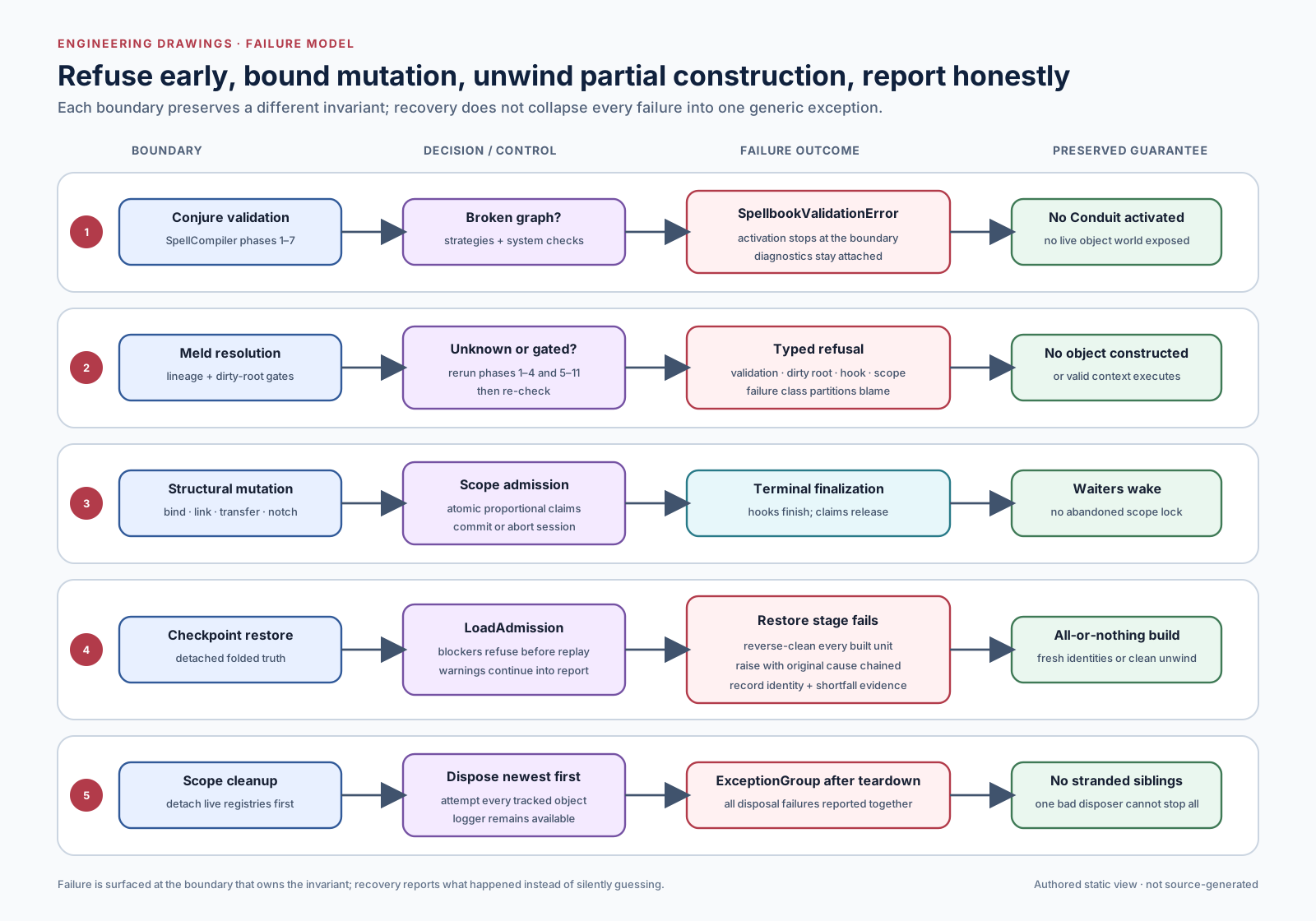
Failure is handled by the boundary that owns the threatened invariant:
SpellCompiler validation refuses a broken graph before a Conduit activates.
Meld checks lineage validity and dirty roots, lazily reruns phases when state is unknown or gated, and returns typed validation, change-control, hook, or scope failures before constructing an object.
Structural transactions finalize through commit or abort and release their scope claims so waiters are not stranded.
LoadAdmission refuses restore blockers before replay. If a RestoreEngine stage later fails, every built unit is cleaned in reverse order and the original cause is chained into the raised error.
Creations attempts every configured disposer newest-first, then raises one
ExceptionGroupcontaining all failures after teardown has completed.
Warnings, identity translations, and unreplayable shortfalls remain explicit report data. Recovery does not claim more continuity than the recorded values can support.
Open full-size SVG ·
Open the Mermaid companion ·
Read governance and change
Advanced System Flows
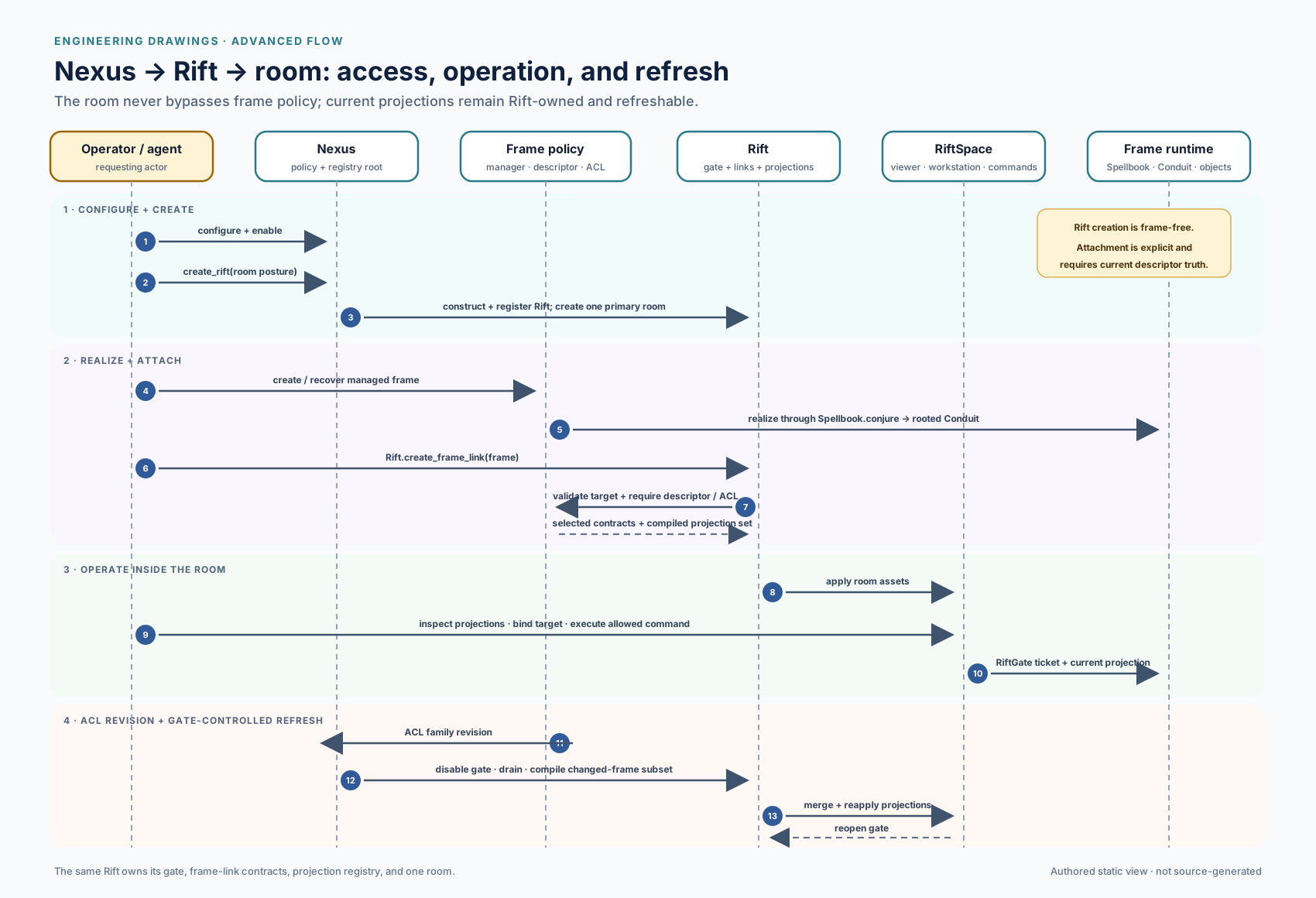
Nexus → Rift → Room
The detailed access flow has four phases:
Nexus is configured and enabled; a Rift is created with one selected room posture.
A managed frame is created or recovered, then attached only after target policy, descriptor truth, and the frame-name ACL contract resolve.
Nexus compiles projection sets; Rift owns the current projection registry and applies it to the room viewer and command assets.
An ACL revision disables impacted Rift gates, drains in-flight tickets, recompiles only the changed-frame subset, reapplies assets, and reopens the gates.
The room therefore never owns lower runtime truth and never bypasses Nexus policy.
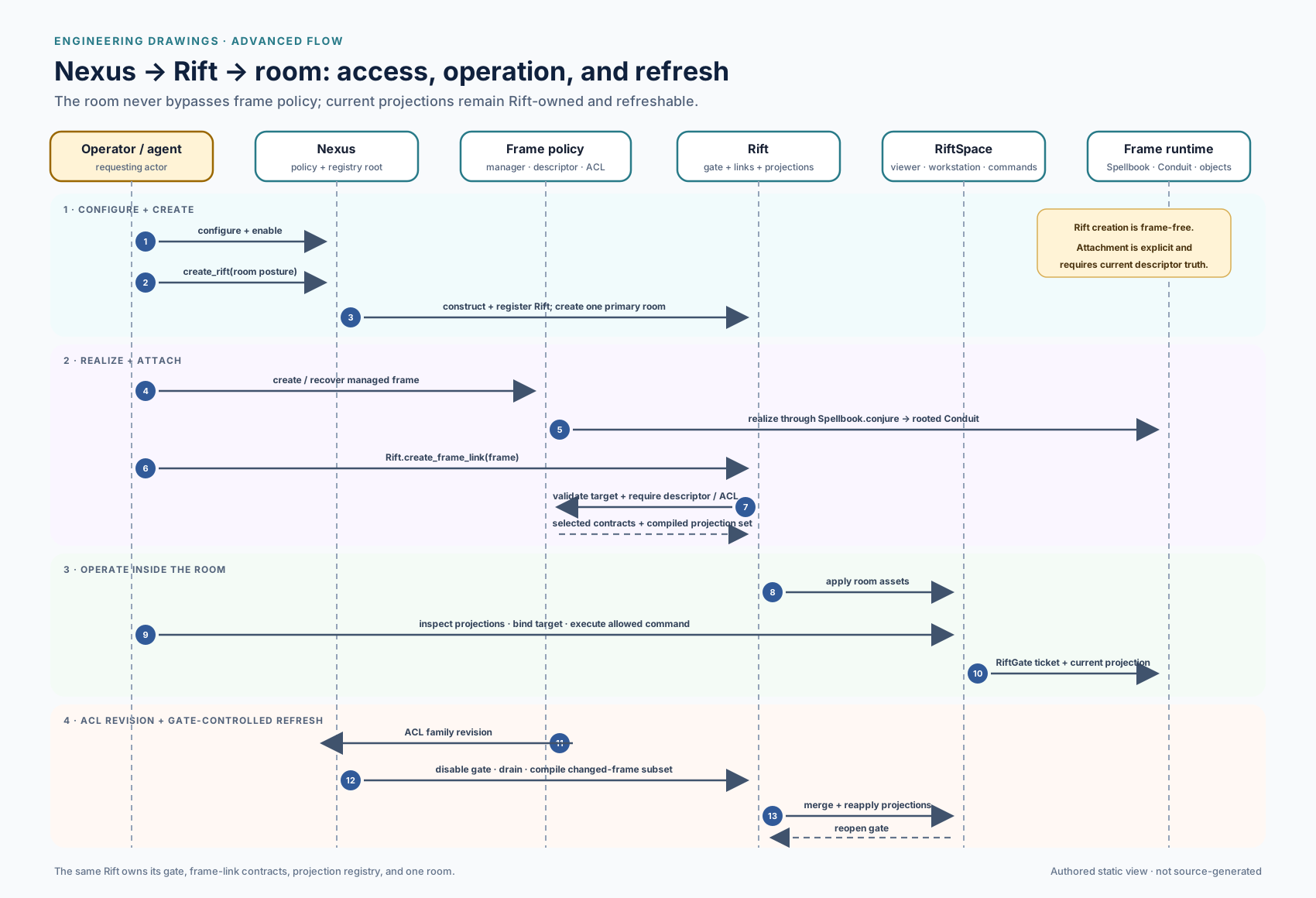
Open full-size SVG ·
Open the Mermaid companion ·
Operate through a Rift
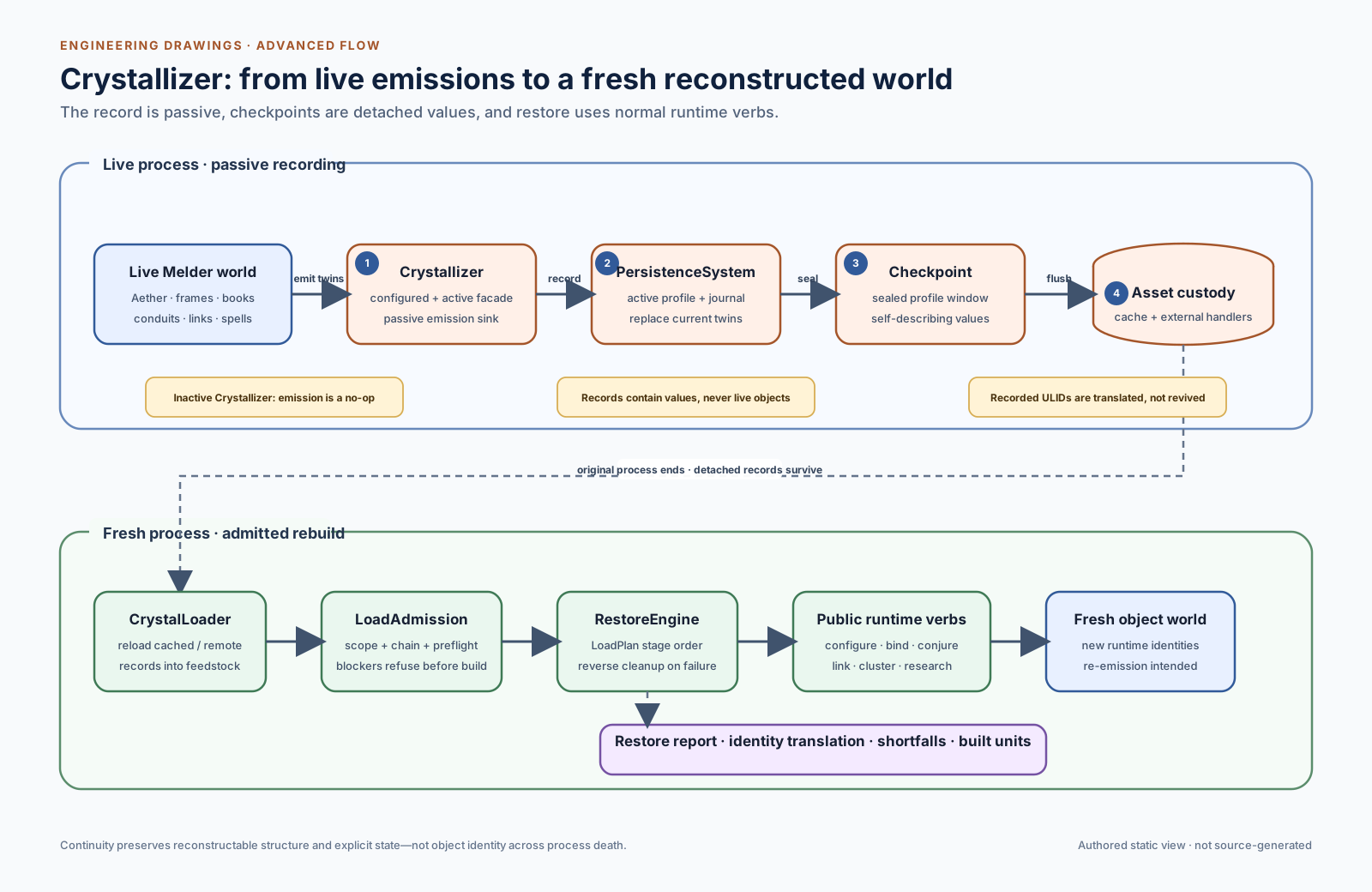
Crystallizer Record and Restore
The live half is passive. Once configured and active, Crystallizer receives lifecycle
emissions and replaces the corresponding twins in the active persistence profile.
PersistenceSystem seals a profile window as detached value data;
AssetManagementSystem places it in local cache or caller-provided external custody.
The cold half starts in a fresh process. CrystalLoaderSystem loads feedstock,
LoadAdmission verifies scope, chain, collisions, and blockers, and RestoreEngine
executes a LoadPlan through normal configuration, bind, conjure, link, cluster, and
research verbs. Runtime identities are freshly minted and the report carries translation
and shortfall evidence.
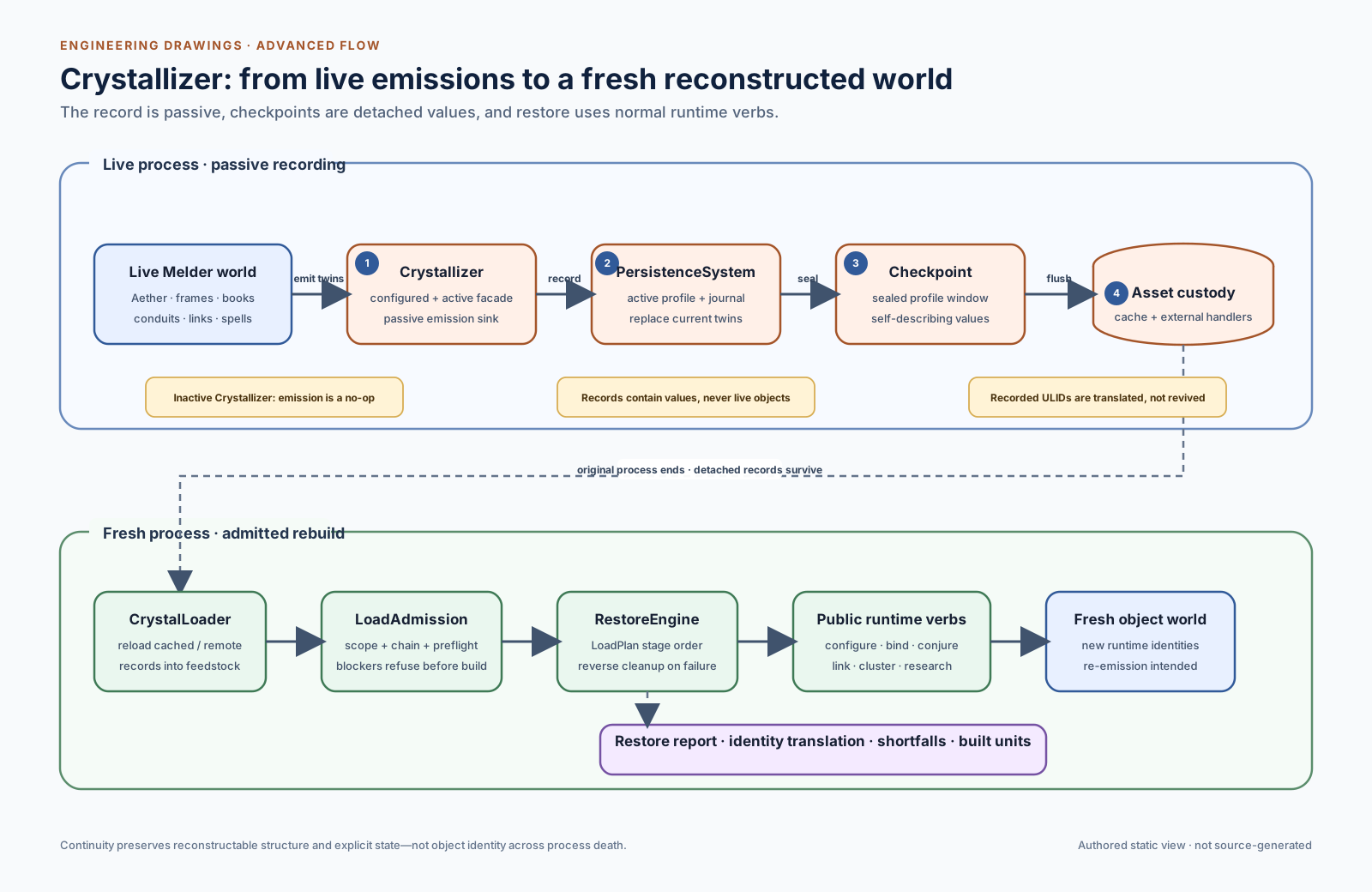
Open full-size SVG ·
Open the Mermaid companion ·
Preserve and evolve a world
MutationResearch Governed Evolution
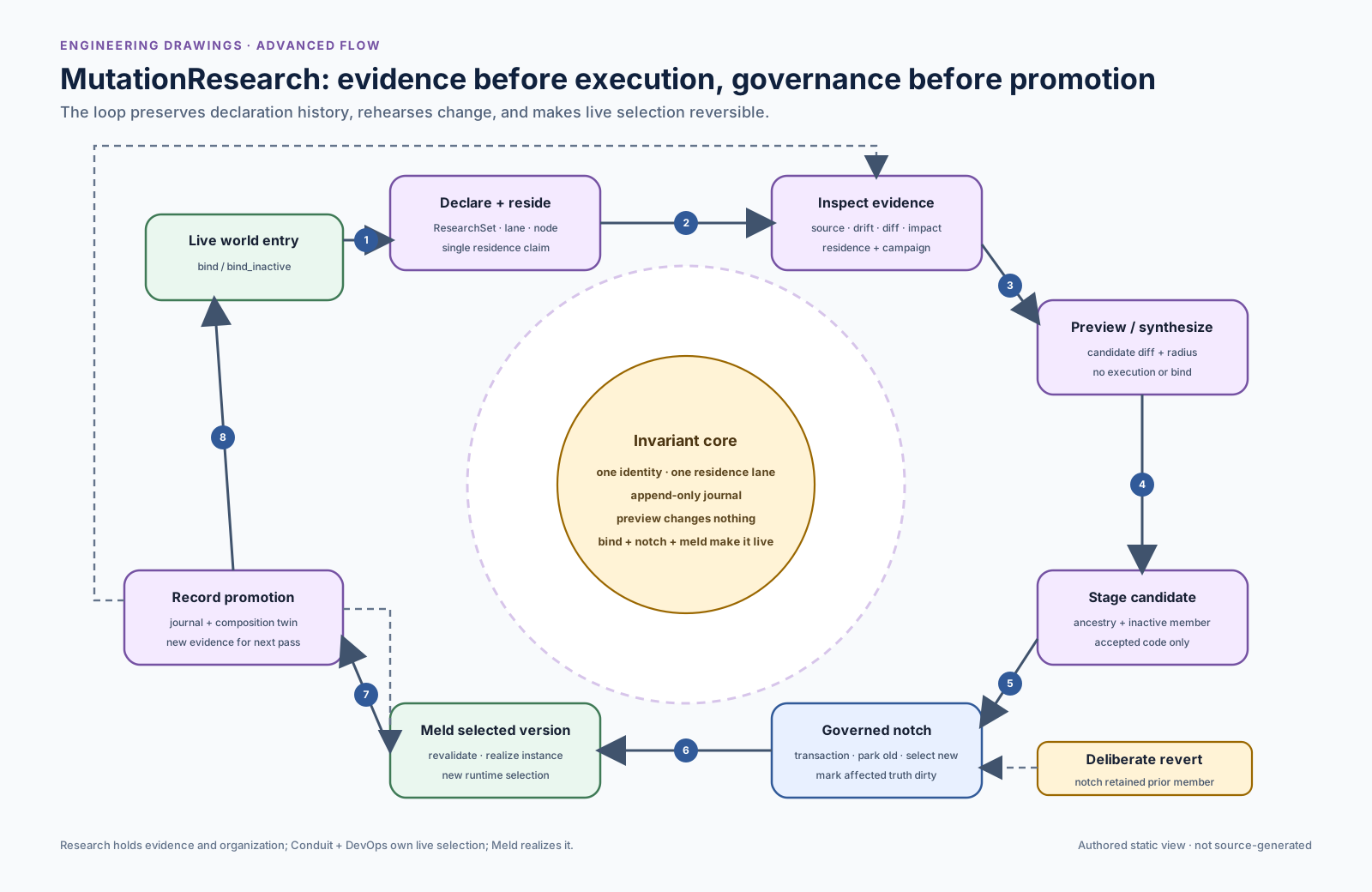
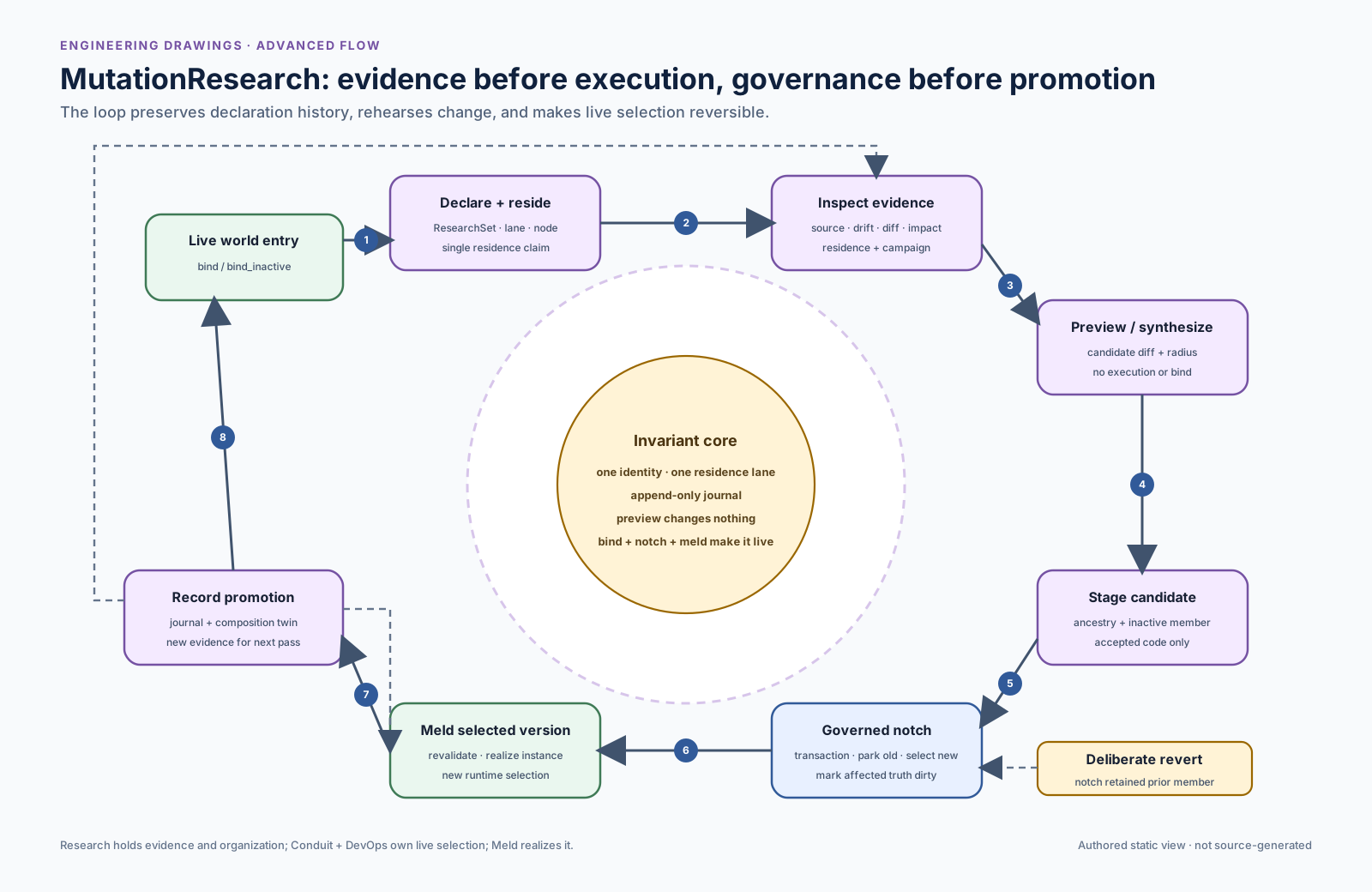
MutationResearch begins with declaration, not mutation. One content identity claims one residence lane, while the append-only journal preserves the event story even when organization snapshots rewind. Foresight reads expose recorded source, runtime residence, drift, diff, and impact before a candidate can affect the live world.
preview_candidate and structural synthesis produce evidence without executing or
binding code. An accepted candidate is staged through ancestry and/or an inactive
SpellIndex member. Promotion then crosses the real runtime boundary: Conduit admits a
notch transaction, Frame DevOps protects the structural change, Meld validates and
realizes the selected version, and the promotion returns to the journal and persistence
twin. Retaining the prior member makes revert an explicit reverse notch.
Open full-size SVG ·
Open the Mermaid companion ·
Read governance and structural change
Provenance and Freshness
The original C4/C3/C2 pairs are byte-identical mirrors of the packaged system-document drawing set. The fourteen introductory, use-case, cross-cutting, and advanced-flow pairs are authored directly in this public documentation lane.
They are intentionally static:
src_graphis not used to derive them.Source changes do not regenerate them.
The handmade SVG and Mermaid companion must be updated together.
The SVG remains the primary human-facing drawing; Mermaid remains the semantic, text-native companion.
That tradeoff preserves architectural judgment and deliberate layout. Ownership, boundary intent, lifetime authority, and the reason for an edge cannot be inferred reliably from syntax alone.